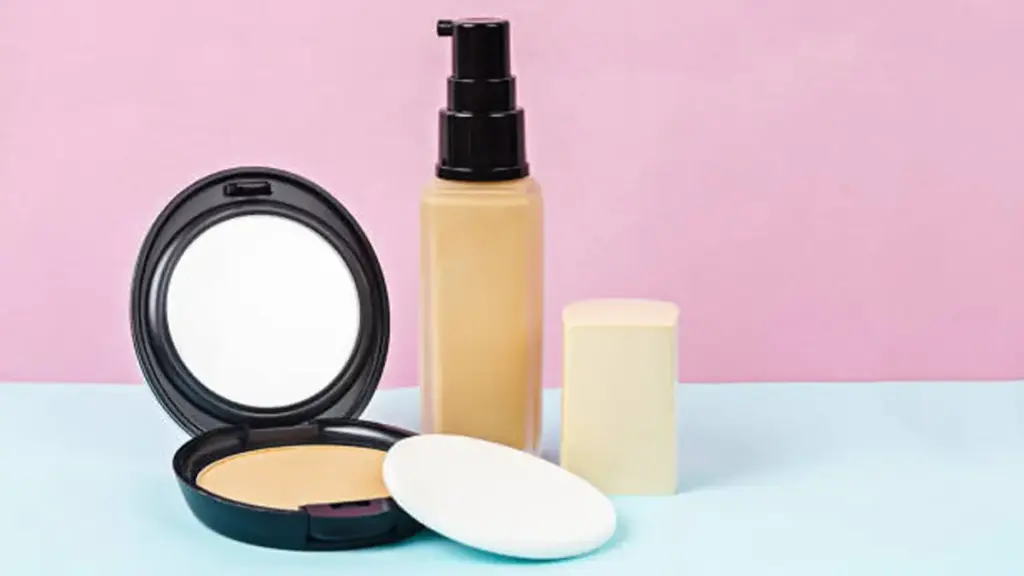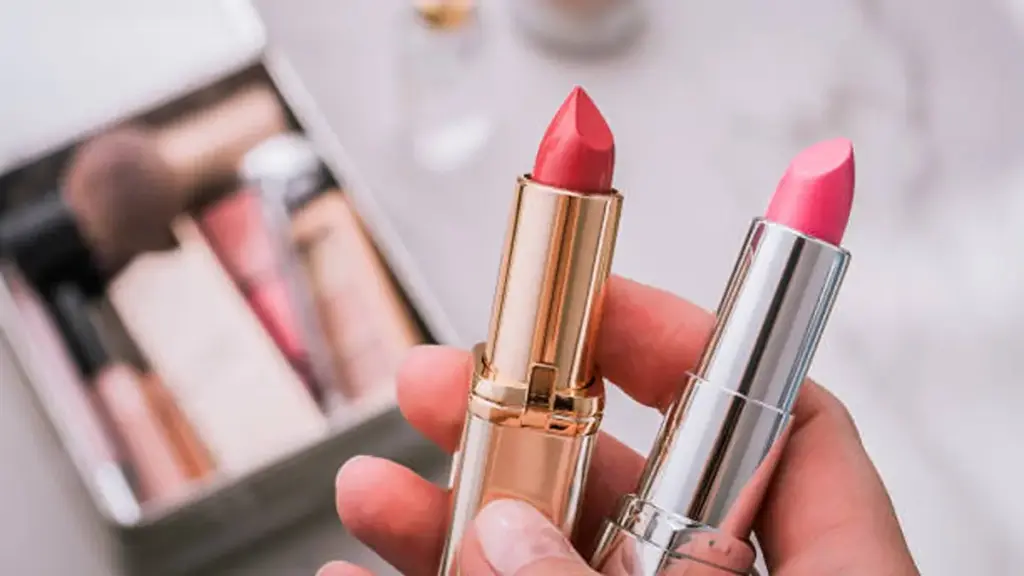

Choosing PCR plastic for cosmetic packaging puts two of your brand promises under pressure: the sustainability story you tell shoppers, and the shelf appearance they expect from you. Recycled resin can arrive with a grey undertone, a faint odor of its previous life, and a melt behavior that differs from the virgin material your tooling was qualified on. Each of those traits can cheapen a premium compact or crack a hinge before a customer even opens the lid.
This guide explains what PCR plastic actually is, where it pays off, where it fails, and how material producers close the quality gap. It ends with a specification checklist you can hand to any packaging supplier, so your recycled content decision becomes a documented engineering choice instead of a marketing gamble.
What Is PCR Plastic?
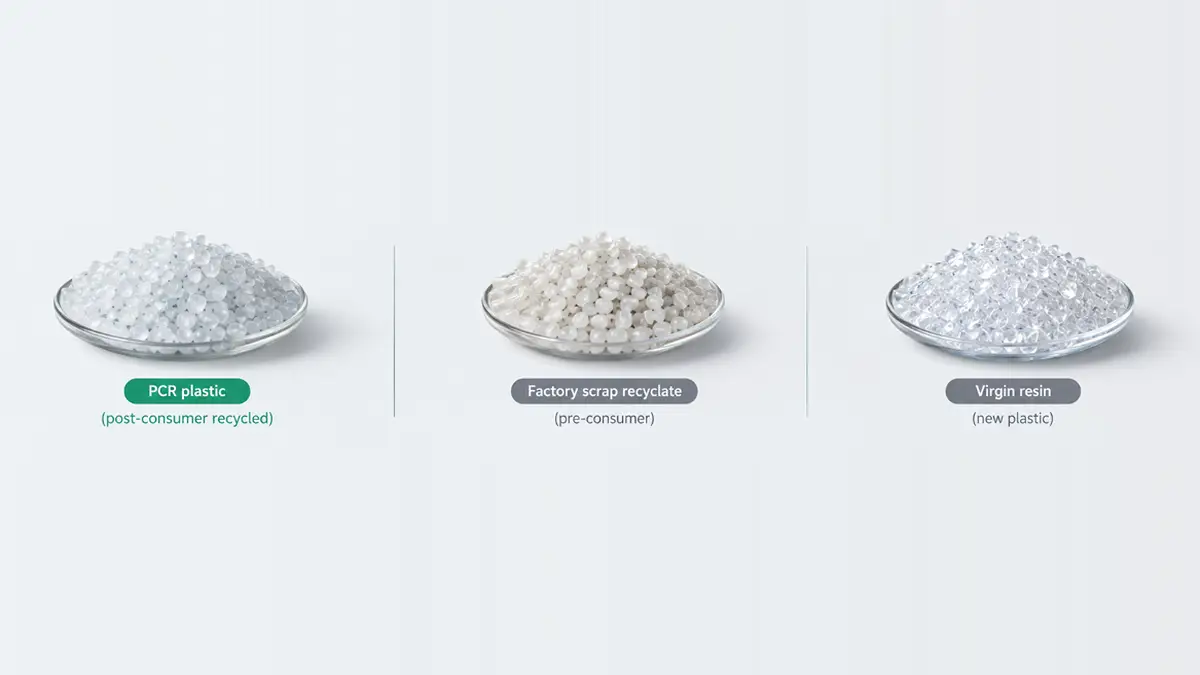
PCR plastic, short for post-consumer recycled plastic, is resin made from products that finished their use with end consumers, were collected through recycling systems, and were reprocessed into packaging-grade pellets. It is distinct from factory scrap recyclate and from virgin resin.
The definition is stricter than it looks. Under the ISO 14021 wording adopted by the Association of Plastic Recyclers (APR), post-consumer material is what end users discard once a product can no longer serve its purpose. A household throws away a shampoo bottle. It goes through curbside collection, gets sorted by resin type and color at a recovery facility, is shredded, washed, and re-extruded into pellets. The bottle that held someone else’s product can become the base of your eyeshadow compact.
This is where a common procurement mistake hides. Much of what gets sold as “recycled” resin is actually post-industrial scrap: sprues and rejected moldings collected inside a factory and fed straight back into the melt. That stream is clean, single-resin, and consistent. It is also not a loop the consumer participated in, so it rarely satisfies regulation or the sustainability claim your marketing team wants to make. Ask which stream you are buying before you ask about price.
In color cosmetics, the PCR streams with real supply behind them are polypropylene (PP), high-density polyethylene (HDPE), and polyethylene terephthalate (PET). PCR PP suits compacts, lipstick mechanisms, and closures. PCR HDPE suits caps and structural parts. PCR PET suits clear outer caps and overshafts where a slight tint is acceptable. Polystyrene sits at the thin end of the supply market, and acrylic (PMMA), long the default for luxury-feel cases, has almost no post-consumer supply. That is why mono-material redesigns keep appearing in packaging briefs.
Finally, decide how the recycled percentage gets counted. Reputable producers certify content through SCS Recycled Content, UL 2809 Environmental Claim Validation, or ISCC PLUS mass-balance certification. The counting model must be declared whenever a recycled-content claim is made. Pigments, metallization, springs, and magnets usually sit outside the calculation. A “100% PCR” case may mean the resin body only. Put the counting rule in your purchase spec.
Benefits of PCR Plastic in Cosmetic Packaging
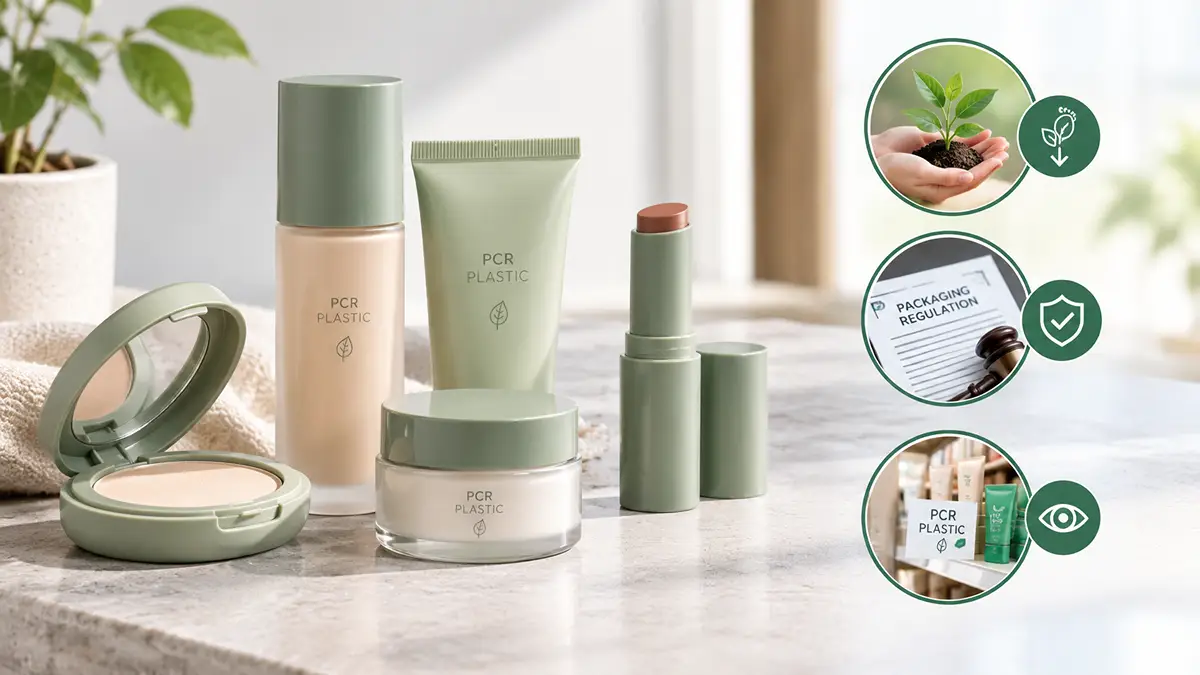
PCR packaging earns its place on three fronts: a measured cut in each unit’s footprint, alignment with tightening packaging law, and a claim shoppers notice at the shelf.
Sustainability Advantages
The personal care and beauty industry produces more than 120 billion units of packaging every year, according to a widely cited industry estimate. Meanwhile the Ellen MacArthur Foundation puts the loss bluntly: about 95% of plastic packaging value, some $80–120 billion annually, leaves the economy after a short first-use cycle. PCR is the direct countermove, because every ton of post-consumer resin is a ton of virgin polymer you do not trigger.
The emissions case is quantified. Lifecycle data commissioned by APR show bottle-grade PCR PET carrying roughly 40–60% lower cradle-to-pellet greenhouse gas emissions than virgin PET, with larger reductions reported for HDPE and PP. Virgin resin also costs 1.7 to 3 times more expended energy to produce than its recycled equivalent. The size of the saving depends on resin, collection system, and allocation method, so ask your supplier for the lifecycle dataset behind any number they quote. Our guide to sustainable lipstick manufacturing covers the factory-side changes that pair with packaging decisions like this one.
الامتثال التنظيمي
Regulation is moving recycled content from voluntary to mandatory, and it reads your category more precisely than most briefs assume. Under the EU Packaging and Packaging Waste Regulation (Article 7), cosmetic packaging counts as contact-sensitive packaging. From January 2030, plastic components in that class must contain at least 10% post-consumer recycled plastic by an annual plant average, rising to 25% in 2040. PET-based components face 30% in 2030 and 50% in 2040. Small parts under 5% of a packaging unit’s weight are exempt.
US rules push the same direction state by state. Washington requires 15% PCR in plastic household-cleaning and personal-care containers from 2025, stepping to 25% by 2028 and 50% by 2031. New Jersey’s rigid plastic container mandate opened at 10%. On claims, the EU’s Empowering Consumers Directive has banned unsubstantiated generic environmental labels since late September 2026. Writing “eco” on a carton without certified PCR behind it is a liability, not a differentiator.
Consumer Appeal
Packaging is where a sustainability promise becomes physically true. Shoppers can feel the difference between a glossy virgin case and a matte, subtly flecked recycled one. A “made with recycled packaging” mark lands at the shelf decision, not inside an impact report nobody reads. Research on off-odor in recycled packaging confirms the reverse effect too: a strange smell on a sustainable-looking product damages how consumers rate the product itself.
For private label brands, PCR is a route to differentiation without a reformulation or a new registration. The same visibility cuts both ways, though. A batch with an off-color lid or a noticeable smell erases the goodwill of ten campaigns, because the disappointment is tactile and immediate. Consumer appeal is the reward you only collect when the quality controls in this guide’s later sections are in place.
Challenges of Using PCR Plastic
Three failure modes account for almost every complaint about PCR cosmetic packaging: color that drifts, odor that returns, and mechanics that behave differently in the mold. They share one root cause: recycled resin carries the history of a mixed waste stream.
Color Consistency
A bale of post-consumer plastic is not one color. It is a crowd of earlier products: grey, cream, faded red, translucent blue. Add the heat each flake survives during reprocessing, and the base resin lands with a yellow or grey tint that moves batch to batch. The trade calls this what it is: recycled content is an intentional impurity, and impurities show.
Pigment loading compensates in one direction only: you can darken toward the target, never brighten away from the grey. The practical consequence for a brand is blunt. Pastel and saturated colors are hard to hold, translucent effects are off the table at high PCR content, and two orders six months apart can show a visible delta. Serious PCR programs specify a tolerance window on the L*a*b color scale and keep a signed golden sample, instead of trusting a Pantone number alone.
Odor Control
Polymers absorb what surrounded them. Fragrances and cleaning products leave residues that stay trapped in the pellet, then release slowly once the part is molded and warmed. APR’s technical team describes it vividly in Packaging Dive’s report on PCR odor and color challenges. Wash a fragrant household-plastics bale at high temperature, and the line smells like the whole laundry aisle heated up. Paper labels make it worse. They do not melt; they burn, and the result is a smoky note in the finished pellets.
Polyolefins, especially PCR PP, have the worst reputation here, and PP is the workhorse of compacts and lipstick mechanisms. Odor is a make-or-break failure for color cosmetics for a simple reason: the customer lifts the lid to their face. A waxy, chemical smell on a lip balm case reads as “recycled” in the worst possible way. Warm warehouses and shipping containers accelerate the off-gassing right before delivery, so the smell gate belongs on molded parts, not just raw pellets.
Mechanical Performance
Every pass through an extruder thermally ages the polymer. Chains break or cross-link, additives deplete, and traces of other resins stay behind. Compounders report the same list of moving parts when virgin resin is swapped for the identical PCR grade: viscosity, color, dimensional stability, stress-cracking resistance, and sensory properties all shift. Injection and fill pressures change with it, which means your molder re-qualifies process settings per lot.
In cosmetics packaging, the failure zones are predictable. Compact flip hinges sit at exactly the geometry where stress cracking starts, and lip balm and foundation formulas are full of oils that attack polycarbonate and some PP parts. A hinge that survives 500 opens with virgin resin may fail far sooner with a high-PCR lot. Material producers flag the risk band honestly: brand color equity, part dimensions, and mechanical properties all come under pressure once PCR passes roughly 30% of a molded part.
How Manufacturers Improve PCR Packaging Quality
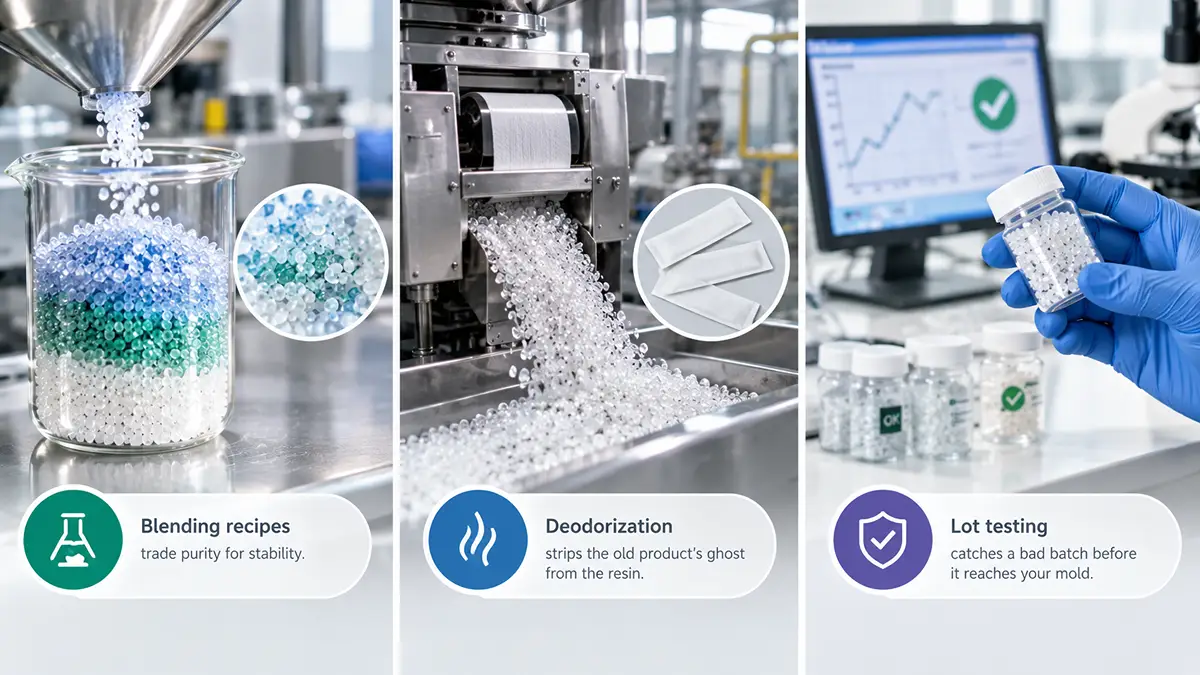
Producers answer the three failure modes with three toolkits. Blending recipes trade purity for stability, deodorization strips the old product’s ghost from the resin, and lot testing catches a bad batch before it reaches your mold.
Material Blending Strategies
Blending is the industry’s first answer. Commercial PCR grades are offered in content steps from 25% to 100%. A PCR-virgin blend keeps melt flow inside the window your tooling expects, dilutes off-color and odor, and still books a defensible recycled percentage. The tier you pick should follow component risk, not the marketing headline. Reality check: the average recycled content across US PET bottles was 16.2% in 2023, the highest year on record, so a well-run 25–50% program is already ahead of the market.
Three design moves extend the safe range. Multi-layer construction hides the PCR: a virgin skin outside with recycled material in the core gives the color and feel of virgin with most of the recycled content. A PCR closure on a virgin container shifts the claim to the biggest non-visible part. Full-coverage labeling masks what pigment cannot. Mono-material design matters too: swapping an acrylic case for a PP construction is usually the difference between “no PCR available” and a certified mid-tier content on the shelf.
Deodorization Technologies
Smell is handled by taking volatiles out of the polymer twice. Washing is the first pass: hot caustic and surfactant cycles at the flake stage, with source segregation upstream, because what the bale contained decides what the flake smells like. A stream kept away from fragrance-heavy product is half the battle before any machine runs.
The second pass happens inside the extruder. Vacuum devolatilization zones pull trapped gases out of the melt under negative pressure before the pellets are cut, and melt filtration strips the particulates that become black specks. For the hardest streams, dissolution-based purification separates the polymer from every additive and odorant in the mix, producing near-odorless PCR PP at a price. None of this is free, which is why certified low-odor resin commands a premium and why a smell protocol belongs in your purchase agreement.
Quality Control Testing
Quality control turns “consistent resin” from a promise into a number set. The framework the US Plastics Pact recommends for buyers is concrete. Demand a certificate of analysis per lot, covering melt flow index at the resin’s standard conditions, density, color values, volatile organic compound (VOC) analysis, and a completed organoleptic sniff evaluation. Each PCR grade should be reviewed against the intended use, because a closure-grade lot and a hinge-grade lot are not the same material.
Part-level testing is the second layer. Color is measured as a delta against the golden sample, not eyeballed. Impact and stress-cracking behavior get verified on actual molded parts, with hinge cycling for compacts. Add a full formula-compatibility hold, since the balm in your product is part of the stress environment. Suppliers who run all of this have real data to hand you. Suppliers who quote only a price do not.
Your Vision, Expertly Packaged and Produced.

How to Choose PCR Packaging for Your Cosmetic Brand
Work the decision in order. Pick the component where recycled resin is safe, choose a resin with mature PCR supply, set measurable tolerances, then make the supplier prove each lot.
| Decision Step | What to Do |
|---|---|
| 1. Start with the right components | Move closures, bases, and opaque shells to PCR first. Leave thin hinges, translucent parts, and color-critical pieces on qualified material until the last phase. |
| 2. Pick the resin before the look | Design toward PP, HDPE, or PET where certified PCR supply exists. Check your lipstick case and packaging material choices against what is actually available. |
| 3. Set the PCR tier by risk, not headline | Choose 25%, 50%, 75%, or 100% per component. A 50% case that ships on schedule beats a 100% concept that never passes color approval. |
| 4. Write tolerances into the spec | Specify the color delta window, melt flow range, odor protocol, black speck limit, and how recycled content is counted. Attach a signed golden sample. |
| 5. Demand certified content and lot data | Require SCS, UL 2809, or ISCC PLUS documentation plus a certificate of analysis per lot. Certification is what makes the claim survive a regulator’s email. |
| 6. Run a real compatibility trial | Fill production samples with your actual formula and hold them through your warmest shipping and storage conditions before signing a purchase order. |
Two practical notes on doing this at speed. First, bring packaging into the product brief instead of after it. Our packaging design service works from the formula and the shelf story together, the only way a PCR choice lands without a redesign loop. Second, judge the supplier on process evidence, not intent. The questions that separate qualified partners from hopeful ones are concrete: which source stream, which deodorization step, which lot-level test data. We covered the full vetting sequence in our guide to finding a reliable cosmetic manufacturer.
الأسئلة الشائعة
Is PCR plastic safe for cosmetic packaging?
Yes, with one condition. Cosmetic packaging faces no food-contact approval requirement, so the recycled resin itself is not the safety question. The real risks are interaction: residual volatiles can taint a scented balm, and stress cracking can let product leak from a failed case. Safety comes from certified material plus formula-compatibility testing, not from the resin label.
Can PCR packaging match a brand’s exact color?
Partially, and the honest answer depends on direction. Dark, opaque shades such as black, navy, and deep burgundy hide the grey base of recycled resin completely. Pastels, brights, and translucent effects sit on the weak end. Specify a color tolerance on the L*a*b scale and a golden sample, and expect one or two pigment rounds when moving from virgin to PCR.
Why does my PCR compact smell after filling?
Because the resin is releasing its past life. Polymers hold onto the fragrances and cleaning agents that surrounded them, and molding plus warmth drives those trapped volatiles back out. A properly washed flake and vacuum-degassed melt should pass a trained-nose check on molded parts. If a case smells, the failure is upstream in the resin, not on your filling line.
What PCR percentage should a makeup brand start with?
Between 25% and 50% is the standard entry point for components that can absorb variation. It clears most retailer expectations and keeps color and mechanics manageable. For scale: US PET bottles averaged 16.2% recycled content in 2023. Check the law where you sell, because the EU sets a 10% post-consumer minimum for non-PET cosmetic packaging from 2030.
Does PCR packaging cost more than virgin resin?
Usually, yes. Collection, sorting, and washing carry costs that virgin polymerization does not, and certified low-odor grades are the scarcest part of the market. The premium moves with oil prices and policy demand, and it widened again in 2024 as virgin PET prices fell while recycled prices held. Verify it per quote, and offset it with lightweighting and mono-material design.
الأفكار النهائية
PCR plastic is a real requirement in cosmetic packaging, not a marketing tactic. Handled well, it cuts virgin resin use, matches tightening regulation, and gives shoppers a promise they can touch. Handled poorly, it delivers off-color lids, odorous compacts, and cracked hinges that damage the brand it was meant to protect. The difference sits entirely in how the material is specified, tested, and bought.
Don’t leave material integrity to chance. The logical next step is to validate these standards with physical components designed for your product line. Connect with our specialists to review technical specifications or arrange for a sample kit.