
Grip Primer Manufacturing is a precise operation where inconsistent polymer hydration or incorrect pH balancing results in total batch failure. This risk directly erodes profit margins and delays product launches, turning a high-demand cosmetic into a significant operational liability.
This analysis breaks down the core production stages, from raw material qualification to automated filling. We evaluate critical process parameters, including controlled shear mixing for gel formation and vacuum deaeration for clarity, to define a repeatable framework for a stable, high-performance product.
What Is a Grip Primer?
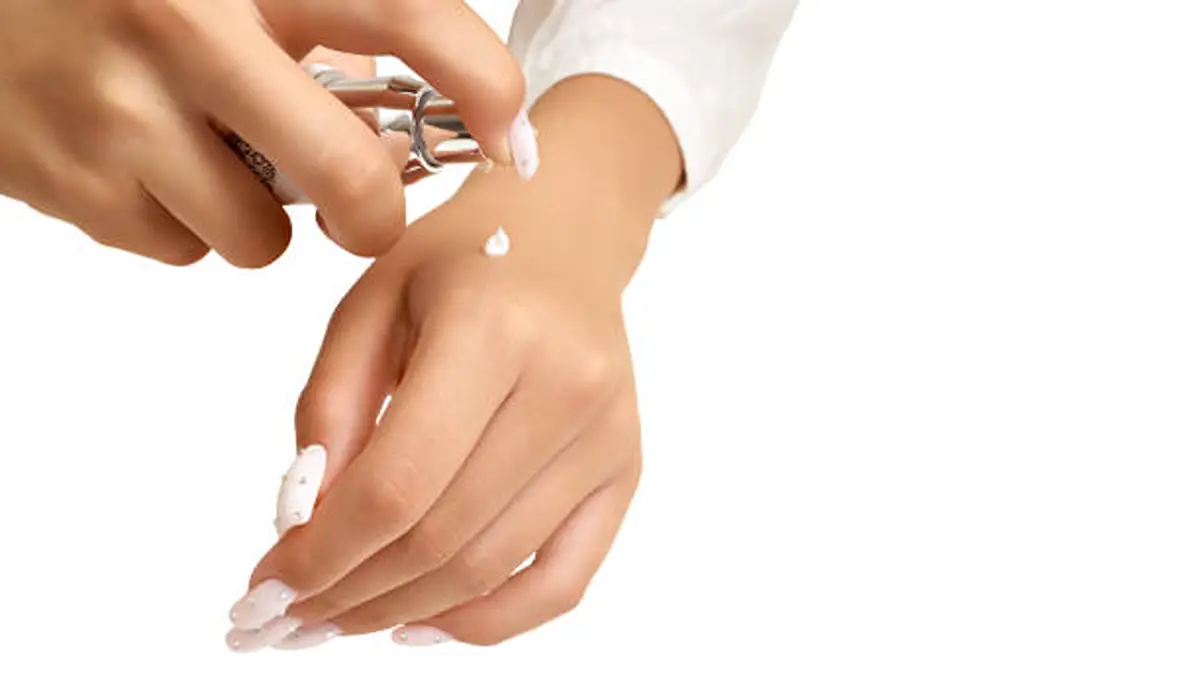
A grip primer is a gel-based formula that creates a tacky surface on the skin. This “grip” helps foundation adhere better and last much longer.
Core Function and Texture
A grip primer’s job is simple: make makeup stick to your face. It’s designed to create a slightly tacky, adhesive surface that grabs onto foundation and other base products, extending wear time and preventing makeup from sliding around, fading, or creasing throughout the day.
The texture is usually a gel or a light serum. When you apply it, it feels hydrating. You let it set for about 30 to 60 seconds, and as it dries, it develops that signature tacky finish. This isn’t a flaw; the tackiness is the entire point. It’s what provides the grip.
How It Differs From Other Primers
Unlike most primers on the market, a grip primer is built for adhesion, not just surface correction. It occupies a specific niche by combining hydration with long-wear performance.
A traditional smoothing primer, often silicone-based, focuses on blurring pores and fine lines. It creates a silky, smooth, and less tacky base for makeup to glide over. Its goal is a perfect canvas. A grip primer’s goal is longevity.
An illuminating primer is all about adding radiance. It uses reflective particles to give the skin a glow from within. Its main purpose is finish, not extending wear time. A grip primer prioritizes holding makeup in place over altering the skin’s texture or glow.
Key Ingredients in Grip Primer Formulas
Grip primers rely on a trio of polymers for tack, humectants for hydration, and texture modifiers to create a stable, spreadable gel that actually works.
Film-Forming Polymers
These ingredients are the foundation of a grip primer’s performance. They create the adhesive, flexible film that gives the product its signature “tacky” quality, helping makeup grab onto the skin and stay put. Formulators choose these polymers specifically to improve makeup longevity and reduce slippage. This approach avoids the heavy, slick feel often associated with traditional silicone-based formulas. A good example is PEG-240/HDI Copolymer Bis-Decyltetradeceth-20 Ether, which helps build the formula’s gel texture and hold.
Humectants and Glycols
Humectants like Glycerin, Sodium Hyaluronate, and various glycols (like Butylene and Pentylene) are included to attract and retain water. Their main job is to provide hydration, which ensures the primer feels comfortable and smooth on the skin instead of tight or drying. They also improve the product’s slip during application, which helps you spread it into an even, non-patchy layer. This combination of hydration and adhesion is what sets grip primers apart.
Texture Modifiers
These ingredients manage the product’s physical properties. They control viscosity, spreadability, and the overall feel to make sure the gel applies evenly without being stringy or runny. Texture modifiers also stabilize the formula, prevent it from separating, and manage how it dries down to achieve the intended tacky surface. Ingredients like PEG-40 Hydrogenated Castor Oil and Trideceth-9 help balance the formula’s tackiness with a smooth, workable application.
Scale Your Beauty Brand with Turnkey Solutions

How Grip Primers Are Manufactured
Grip primer production is a precise, multi-stage process focused on creating a stable, tacky gel by mixing polymers and humectants, adjusting for performance, and packaging the result.
Manufacturing a cosmetic grip primer isn’t about just making something sticky. It’s a controlled process that turns specific raw materials into a stable, skin-compatible gel with just the right amount of tack. The entire operation is designed for consistency, from sourcing ingredients to filling the final tube.
| Manufacturing Stage | Key Activities |
|---|---|
| Raw Material Preparation | Sourcing and qualifying cosmetic-grade polymers and humectants. Each material undergoes QC testing for purity before powders are sieved to prevent clumping. |
| Mixing and Emulsification | Combining ingredients in a specific sequence within temperature-controlled steel vessels. The batch is mixed under controlled shear, then deaerated under vacuum. |
| Stability Adjustment | Adjusting pH for skin compatibility and polymer performance. Viscosity is fine-tuned for the target gel texture, and tack is verified with performance tests. |
| Filling and Packaging | Transferring the finished gel to an automated filling line. Precise amounts are dispensed into airless pumps or tubes, followed by final QC checks. |
Raw Material Preparation
The process starts with sourcing and qualifying cosmetic-grade raw materials. The key functional ingredients include film-forming polymers for tackiness, rheology modifiers to create the gel texture, and humectants like glycerin for hydration. Each material arrives with a spec sheet, and it must pass quality control testing for purity and identity before it enters production. Any powders, especially gel-formers, are sieved to break up clumps and ensure they disperse smoothly. Some ingredients might even be pre-dissolved in a carrier to guarantee a smooth integration during the main mixing phase.
Mixing and Emulsification
The batching itself happens in jacketed, temperature-controlled stainless-steel vessels. The order of addition is critical. Typically, the water phase is added first, followed by the slow dispersion of gelling agents and gripping polymers under controlled shear. The goal is to fully hydrate the polymers without incorporating too much air. Once the batch achieves a uniform gel consistency, it’s deaerated under vacuum. This step pulls out any trapped air bubbles, which are unacceptable in a clear gel and can cause inaccurate fills. Finally, the bulk product is filtered to catch any undispersed particles, ensuring a perfectly smooth final product.
Stability Adjustment
After mixing, the bulk gel is fine-tuned. The pH is adjusted to a skin-compatible range, usually between 5.0 and 7.0, which also optimizes the performance of certain polymers. Viscosity is checked and adjusted to hit the target texture—a gel that spreads easily but doesn’t drip. Performance is then verified through practical tests. This includes simple finger tack tests and more rigorous accelerated stability studies, where samples are exposed to heat and freeze-thaw cycles. These tests predict the product’s long-term quality and ensure it won’t separate or lose its grip on the shelf.
Filling and Packaging
Once the bulk gel passes all quality checks, it is transferred to the filling line. This uses pumps designed to handle viscous products without introducing air or applying excessive shear. Automated filling machines dispense a precise, repeatable amount of primer into its primary packaging, which for this product type is usually an airless pump or a squeeze tube to protect the formula. During this final stage, on-line quality checks verify fill weight, proper sealing, and correct batch coding and labeling before the finished goods are approved and released for distribution.
Common Challenges in Grip Primer Production
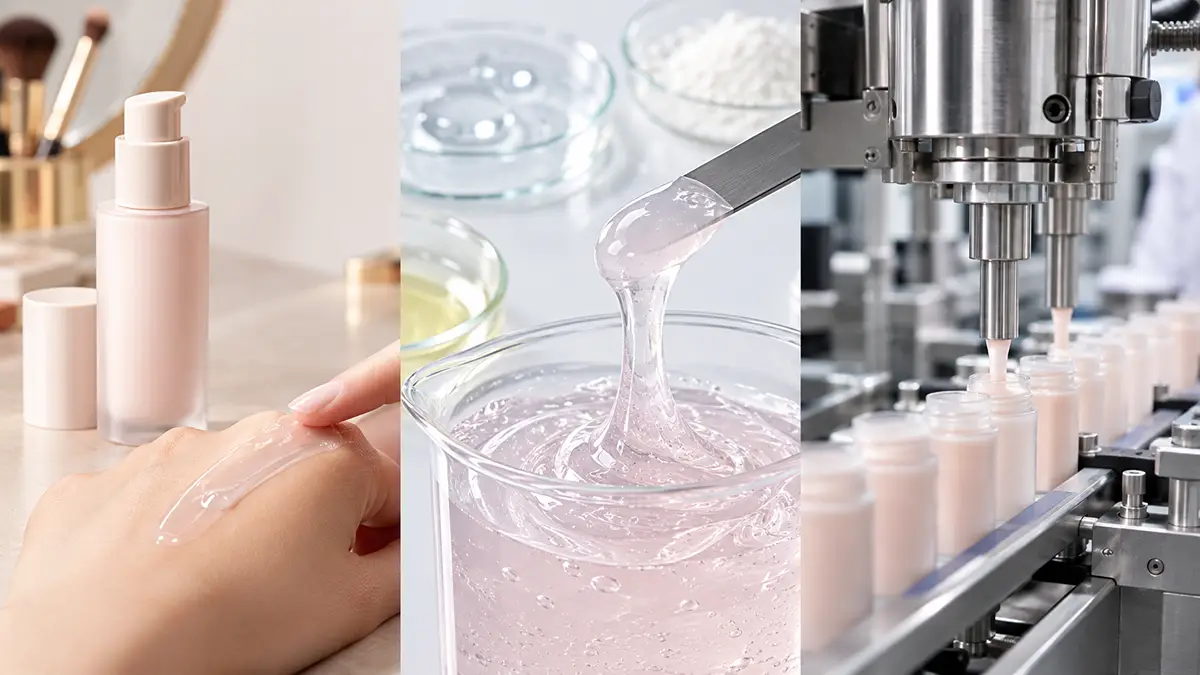
Making grip primers requires balancing tackiness with comfort, keeping active ingredients stable, and controlling tricky process variables like polymer hydration and viscous gel filling.
Formulation and Ingredient Stability
The biggest formulation hurdle is hitting the right level of “tack.” The product has to be sticky enough to grip makeup all day but not so sticky that it feels unpleasant or causes foundation to pill. This requires a precise balance of film-forming polymers and humectants like glycerin. Too much grip, and makeup application becomes difficult. Not enough, and the product is just another hydrating primer.
When you add active ingredients like niacinamide, stability becomes a major issue. Niacinamide is sensitive to pH. The formula’s pH needs to keep the niacinamide stable, activate the gelling polymers correctly, and ensure the preservative system works—all while being safe for skin. High levels of humectants, which are essential for the tacky feel, can also draw moisture from the air and reduce the film’s grip over time, especially in humid conditions.
Since many grip primers are clear gels, maintaining that clarity is another challenge. You have to get the refractive index of the water, humectants, and polymers just right. Any misstep, or incorporating air during mixing, can turn a crystal-clear gel into a cloudy mess.
Manufacturing Process and Quality Control
Scaling up production brings its own set of problems. Many gel-forming polymers, like carbomers, must be hydrated perfectly. If not dispersed correctly in the tank, you get “fish eyes”—small, undispersed clumps of polymer that ruin the texture. The order in which you add ingredients is also non-negotiable. A small deviation can cause ingredients to fall out of solution or prevent the gel from forming properly, leading to an entire batch being wasted.
Filling these high-viscosity, tacky gels into consumer packaging, like pumps, is notoriously difficult. The product’s thickness makes it hard to achieve accurate and repeatable fill weights. Air pockets are a constant risk, which can cause the pump to fail and looks bad to the consumer.
Finally, ensuring consistent performance is a quality control nightmare. “Grip” is a sensory attribute, not something easily measured by a machine. Factories must develop standardized panel tests or mechanical friction tests to quantify performance. This ensures that batch #100 feels and performs exactly like batch #1. This testing must also account for compatibility with a huge range of foundation formulas—from water-based to silicone-based—to prevent pilling and ensure the primer works as advertised for everyone.
How Manufacturers Test Grip Primer Performance
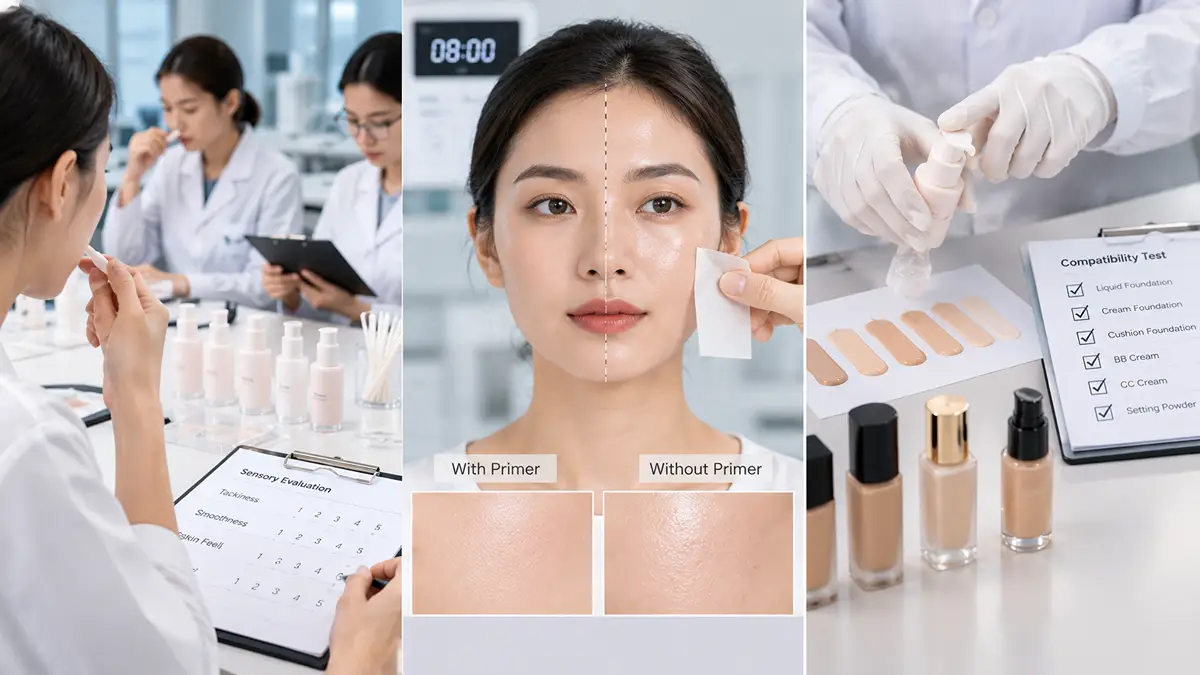
Performance testing for grip primers combines sensory panel data, real wear trials, and stability studies. Panels quantify tack, half-face tests prove longevity, and compatibility checks protect the formula under every foundation a customer might layer on it.
Sensory Panel and Wear-Time Tests
Testing begins on skin, not in a machine. A gel that measures perfectly on a rig means nothing if it feels like tape on a face. Manufacturers apply the same panel discipline they use when confirming how waterproof mascara is tested, then adapt each protocol for a leave-on face product.
- Tack Panel Ratings: trained evaluators dose a fixed amount, wait 30 to 60 seconds, and rate stickiness against a reference scale. The passing band is narrow: enough grab to hold foundation, low enough drag that blending stays smooth.
- Half-Face Wear Trial: primer goes on one side of the face, a base is layered over it, and wear is photographed at 4, 8, and 12 hours under controlled heat and humidity. The untreated side serves as the control, isolating primer performance from foundation variables.
- Sebum and Sweat Resistance: synthetic sebum and sweat solutions are applied over the set film. A primer that grips on clean skin but collapses on oily skin generates returns no brand wants to absorb.
Stability, Safety, and Compatibility Testing
The second battery of tests protects the product across its shelf life and across the wide range of formulas customers use on top of it.
- Accelerated Stability: samples sit at elevated temperature, commonly 40 to 45°C, and cycle through freeze-thaw conditions for 8 to 12 weeks. Clear gels are re-checked for clouding, phase separation, viscosity drift, and any loss of tack.
- Foundation Compatibility Matrix: the primer is paired with water-based, silicone-based, and hybrid bases, applying the same cross-layer discipline documented in our liquid foundation manufacturing process. Pilling or sliding in any pairing blocks release.
- Preservative and Mildness Checks: a preservation challenge test confirms the system survives a humectant-rich gel, and repeated patch testing backs up mildness claims before packaging is approved.
No single number clears a formula. A batch is released only when every parameter—tack, wear, clarity, pH, viscosity, microbial safety—sits inside the agreed spec. That spec then becomes the contract every future production batch is measured against.
How to Develop a Custom Grip Primer
Developing a custom grip primer is a sequence of narrowing choices: define the feel, adapt a proven base, prove stability, and freeze the spec before scale-up. Brands that skip straight to sampling pay for it in reformulation rounds.
Defining the Brief and Performance Targets
Serious development starts with a written brief, not a mood board. Before the lab touches a beaker, the brand and the factory agree on four points.
- Tack level and finish: everyday grip versus maximum hold for stage and camera work, drying down natural or dewy rather than a tight matte pull.
- Skin feel constraints: hydration depth, product weight, and whether actives such as niacinamide belong in the formula at all.
- Packaging format: an airless pump and a squeeze tube demand different viscosities. The pack choice is a formula decision, not just a design one.
- Target markets: US and EU launch paths diverge on claims and required documentation, which changes what the safety file must contain.
Brands that have already run a custom lip gloss formula will recognize the structure. The variables change; the workflow doesn’t.
From Lab Sample to Production-Ready Formula
With the brief signed, development moves in rounds. The fastest route starts from a proven stock base rather than a blank sheet. Our base de teint range already clears stability and compatibility testing, so lab time goes into feel, claims, and differentiation instead of rebuilding a gel from zero.
- Sample rounds: lab samples are evaluated for tack, set time, and pilling, then adjusted. Two to three rounds is normal; more usually means the brief was vague.
- Compliance documentation: ingredient screening against each market’s restricted lists, safety assessment, and label claims are drafted while the formula is still movable.
- Pilot batch: before full production, a pilot run proves the mixing sequence, vacuum deaeration, and fill weights hold at real line speed, not just in the beaker.
Documentation is not administrative overhead. For US-bound orders, the Modernization of Cosmetics Regulation Act of 2022 (MoCRA) requires a responsible person to maintain records supporting adequate safety substantiation for every product placed on the market. EU entry adds its own file requirements before first sale. A factory that works in both systems keeps launch timelines symmetrical across markets.
Frequently Asked Questions
What ingredients give grip primers their adhesive strength?
Their grip comes from a combination of humectants and film-forming polymers. Humectants like glycerin or hyaluronic acid keep the formula slightly moist and tacky on the skin. Film-forming polymers then create a thin, flexible layer that makeup can mechanically cling to, which extends its wear time.
Why does my foundation sometimes pill when applied over a grip primer?
Pilling usually happens for a few key reasons: formula incompatibility (like a water-based foundation over a silicone primer), applying too much primer, or not waiting long enough for the primer to set. For a smooth result, use a pea-sized amount and wait about 30-60 seconds for it to become tacky before applying foundation.
How long does a grip primer need to dry on skin?
A cosmetic grip primer doesn’t fully “dry”; it sets to a tacky finish. This typically takes about 30 to 60 seconds. This tacky surface is what helps your foundation adhere better. Applying a thick layer or being in a very humid environment can extend this setting time.
What nozzle design prevents sticky cosmetic liquids from stringing during filling?
To stop stringing, factories use short, straight, single-orifice nozzles. These are positioned very close to the container and fire straight down. This setup creates a clean, direct flow that breaks off neatly without creating sticky threads when the filling stops.
How are high-tack formulas cleaned out of factory mixing tanks?
Factories use a multi-step process in sanitary stainless steel tanks. After draining as much product as possible, the tank is pre-rinsed with hot water to soften the residue. A cycle with specialized detergents then breaks down and removes the tacky film, followed by thorough water rinses to ensure the tank is completely clean for the next batch.
Réflexions finales
Understanding this manufacturing process reveals a critical business choice. While generic formulas offer lower costs, only a precise balance of polymers, viscosity control, and stability testing can prevent product failure. This technical discipline is the only safeguard for your brand’s reputation against inconsistent batches and poor performance.
Don’t guess on quality when your market share is on the line. We recommend you start by testing our stock formulations to verify the tack, feel, and durability for yourself. Contact our specialists to request product samples or to begin your custom development project.