
The choice of silicone vs water-based primer is a technical decision that directly impacts manufacturing cost, production line stability, and brand positioning. Pick a base that fights your skincare claims, or one your filling line cannot handle, and the margin you planned to earn goes to rework instead.
This comparison benchmarks both formulations against the metrics a private label program actually runs on. We weigh the cost drivers of silicone elastomers against water-phase humectants, set out the stability and documentation each base demands, and note where the two production models diverge.
Quick Overview: Silicone vs Water-Based Primers
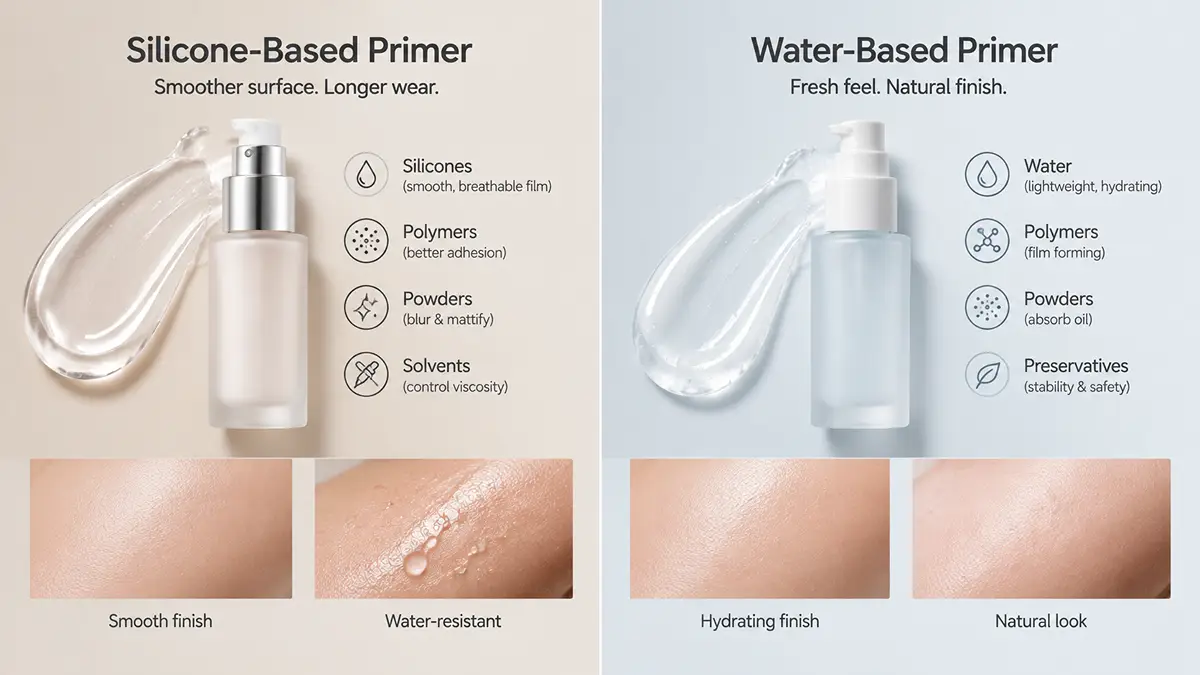
Water-based primers deliver hydration and a natural, lightweight feel. Silicone-based primers use polymers to blur texture and lay down a smooth, velvety film under makeup.
Composition and Feel on Skin
Water-based primers list water first, which gives them a thin, fluid or gel-like body. They absorb into the skin rather than sitting on it, so they feel closer to a light serum than to a makeup step.
Silicone-based primers are built on silicone polymers such as dimethicone. These formulas keep a distinct silky, velvety slip. They form a smooth, cushioning film on top of the skin instead of absorbing into it.
Primary Function and Suitability
A water-based primer’s main job is hydration. It settles dry patches so foundation lies flat and looks like skin. Brands usually point it at dry, sensitive, or acne-prone buyers.
Silicone-based primers excel at blurring. They fill fine lines, soften the look of pores, and hold oil back for a soft-focus, matte finish. That makes them the usual pick for oily, combination, or textured skin.
Silicone-Based Primer Benefits and Limitations
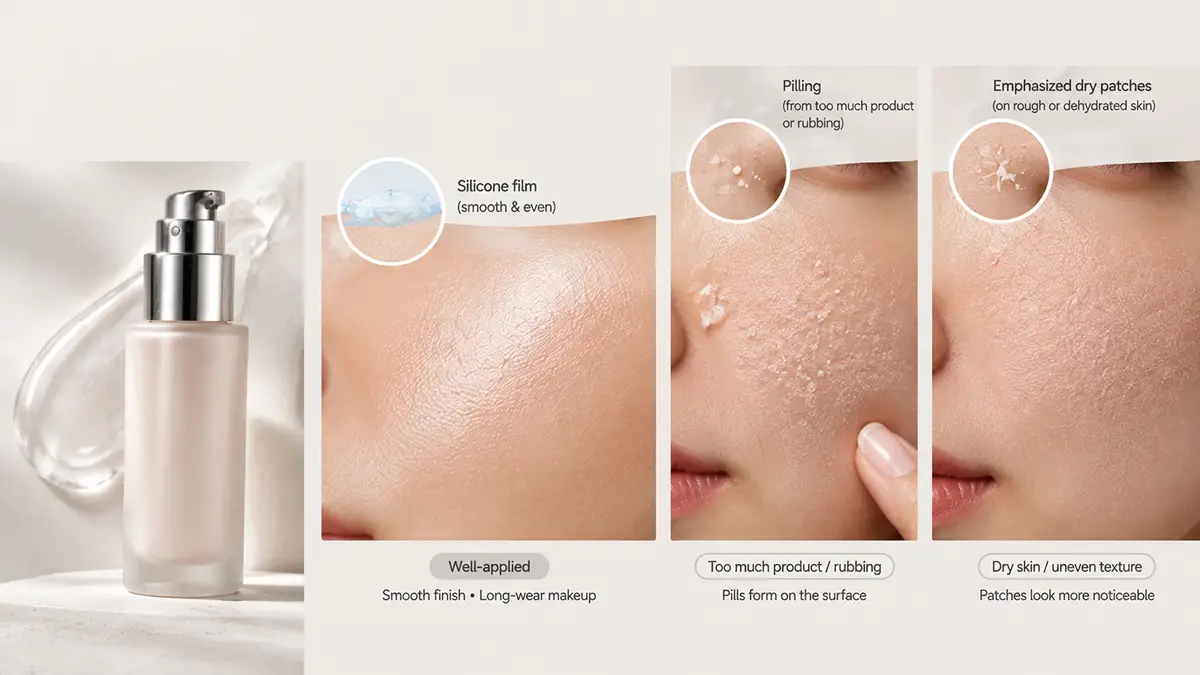
Silicone primers build the best smoothing film for long-wear makeup. That same film punishes careless application with pilling and emphasized dry patches.
Smooth Skin Texture Effect
Silicone polymers such as dimethicone lay a silky film across the skin surface. That layer fills fine lines and uneven areas, so foundation glides instead of catching on rough patches. Buyers describe it as a slip-and-glide feel.
Two limits come with the film. It is a cosmetic mask, not a skin treatment, so nothing about the underlying texture changes. And on dry skin that has not been moisturized first, the film grips the flakes and makes them more visible, not less.
Pore-Blurring Effects
Silicones create a soft-focus optical effect. They partially fill the pore opening and scatter light across it, so pores read as smaller and shallower. The effect is cosmetic and washes off at night.
Done properly, a silicone primer blurs more than a water-based one can. That is why the blur claim shows up on elastomer gel formulas far more often than on hydrating ones, and why photographers and long-event buyers reach for this base.
Makeup Longevity Performance
The film acts as a flexible barrier between skin and foundation. It slows the sweat and sebum that otherwise break makeup down, which improves adhesion and fade resistance. For events that run eight hours or more, this is the base most brands formulate around.
Layer it wrongly and the same barrier works against you. Applied too thick, or paired with a water-based foundation that cannot bond to it, the two phases slide apart and roll off in little balls. Pilling is the single most common complaint against silicone vs water-based primer pairings, and it is a layering problem, not a quality defect.
Launch Your Face Primer Line With the Right Base

Water-Based Primer Benefits and Limitations
Water-based primers feel light and wear cleanly all day. They lose on blur strength, and they will not hold up under a heavy silicone foundation.
Lightweight Feel on Skin
A water-based primer has a thin body, so it spreads easily and sets quickly. Buyers who dislike the coated feeling of a primer choose this base for that reason alone.
Weight still matters in application. One heavy pour of a hydrating primer sits tacky and can drag foundation as it dries. Two thin layers, with a short set between them, give a cleaner result than one thick one and read as skin.
Hydration Benefits
Water is the solvent, and the formula carries humectants such as glycerin or hyaluronic acid with it. Those ingredients pull moisture into the upper layers and hold it there through the day.
For a brand, the marketing read is simple: a hydrating base lets you put a skincare claim on a makeup bottle. It also lets the product sell to buyers who skip foundation on most days and still want that step to do something for their skin.
Compatibility With Skincare-Focused Routines
This is where a water-based base earns its place in a routine. It layers cleanly over moisturizer, sunscreen, and serums, most of which are also water-continuous. Nothing beads or breaks, and the whole stack feels like one product instead of four.
The limit sits at the other end of the routine. A heavy silicone foundation or a long-wear matte stick will not bond to a hydrating primer the way it bonds to a matching silicone base. If the rest of the line is built for wear time, a water-based primer works against it. Some brands solve that by keeping both bases on the shelf and telling customers which pairs with which.
Key Formula Differences
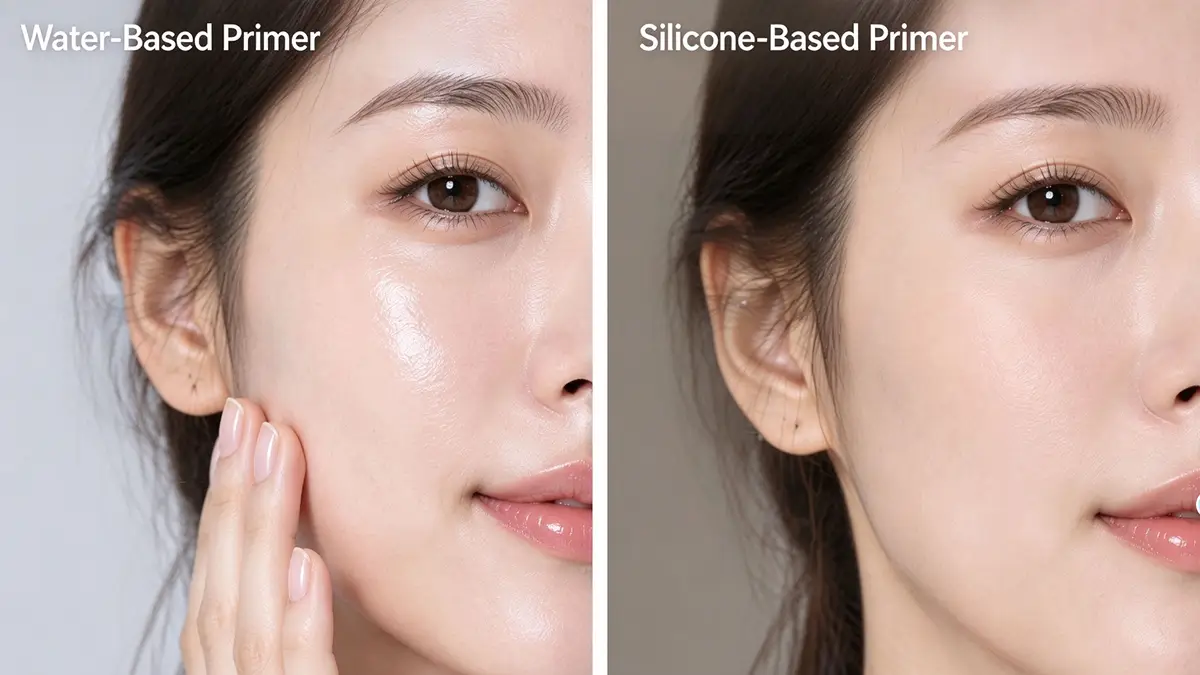
Water-based primers run on humectants for hydration and a fresh feel. Silicone-based primers run on polymers for a velvety, blurring film that lasts.
Ingredient Systems
The INCI list tells you which base you are holding, and quickly.
- Water-Based: Aqua sits first, followed by humectants such as glycerin or sodium hyaluronate. Those names lead the label.
- Silicone-Based: The first entries end in -cone, -methicone, or -siloxane. Those polymers build the structure of the primer, not just its feel.
Texture Characteristics
The two bases behave differently the moment they hit skin, and no amount of added ingredient changes that.
- Water-Based: Light, serum- or gel-like. It absorbs and leaves a fresh, often dewy surface.
- Silicone-Based: Velvety with a distinct slip. It stays on top as a smoothing layer and dries to a blurred, soft-matte surface.
Performance Differences
Each base is engineered for a different job, so judge them on different outcomes.
- Water-Based: Comfort and hydration. The expected result is a natural finish the wearer forgets is there.
- Silicone-Based: Blur, oil control, and wear time. The expected result is visible the second foundation goes on.
Which Primer Base Suits Each Skin Type
Skin type settles the silicone vs water-based primer question faster than any claim does. Silicone manages oil and texture; water carries hydration and comfort.
| Skin Type | Recommended Base |
|---|---|
| Oily | Silicone-based |
| Dry | Water-based |
| Combination | Both, applied by zone |
| Sensitive | Water-based, short ingredient list |
Oily Skin Recommendations
Silicone-based is the clear choice here. The film mattifies, holds shine back, and softens the look of enlarged pores. Just as important, it keeps sebum from reaching the foundation above it, which is what actually shortens wear on oily skin.
For a brand, oily skin is also the easiest audience to sell to, because the result shows up the same day. Blur and oil control are claims a customer can verify in a mirror, so samples convert on this base more reliably than on a hydrating one.
Dry Skin Recommendations
Water-based primers do the better job. A hydrating formula is effectively a layer of water-holding serum under the makeup, so foundation has no flakes to cling to. The finish reads dewy rather than flat.
Watch what sits underneath. Dry skin still needs its moisturizer to do the work; a hydrating primer extends it, it does not replace it. Brands that position the primer as one step for very dry customers tend to collect the complaints.
Combination Skin Approach
Combination skin wants both bases, applied by zone. A mattifying silicone primer across the T-zone controls shine and pores, while a hydrating water-based primer on the cheeks keeps those areas from tightening through the day.
That approach has a product line consequence worth planning for. Zone application means either two SKUs, or one hybrid formula engineered to do both. Hybrid primers are where most of the formulation difficulty sits, because you are asking a silicone film and a humectant phase to behave well in the same bottle.
Sensitive Skin Considerations
Stay on the water-based side. The formulas are lighter, more breathable, and far less likely to feel heavy or block pores. Ask the factory for a short ingredient list and a fragrance-free version, since fragrance and botanical extracts drive most reported reactions.
Preservation is the part to check with your OEM partner. A water-rich formula needs a working preservative system, and that is a common irritant source. Pair the request with stability and challenge-test data rather than a marketing claim about being gentle.
How Beauty Brands Choose Between Silicone and Water-Based Primers
Brands choose on three inputs: who buys the product, how it is marketed, and what the line can actually run. It is a call between performance and skincare.
| Decision Factor | Silicone-Based Focus | Water-Based Focus |
|---|---|---|
| Target Customers | Oily, combination, or textured skin; blur and long wear | Dry, sensitive, dehydrated skin; hydration and comfort |
| Product Positioning | Flawless, velvety, matte; professional performance lines | Hydrating, dewy, skin-like; clean and skincare-led lines |
| Cost Driver | Specialty silicone elastomers and volatile carriers | Skincare actives plus a full preservative system |
| Production Fit | Dedicated mixing and paste filling; very stable once made | Runs on skincare cream lines; stability work is heavier |
Target Customers for Each Base
The decision starts with who buys the product. Silicone-based formulas go to customers with oily, combination, or textured skin who want visible blur and a base that survives a long day. Water-based formulas go to customers with dry, sensitive, or dehydrated skin who put comfort first.
Occasion splits the same audience again. Makeup worn for events, photography, or warm climates pushes buyers toward silicone. Everyday wear and skincare-first routines push them toward water. A brand that sells to both usually ends up running two primers rather than one compromise formula.
Product Positioning Decisions
Claims follow the base. Silicone primers get sold on a flawless, matte, velvety finish and on wear time. Water-based primers get sold on hydration, a dewy look, and a skin-like feel.
Brand identity decides how much room those claims have. Performance and professional makeup lines build reputation on the reliable grip of a silicone base. Clean, natural, or dermatological lines lean water-based to support a skin-health story. Either way, brands pair the primer with their own foundation line and tell customers which goes with which, because a mismatched pairing is what reads as a product failure.
One regulatory note applies to both bases equally. Under EU Regulation 1223/2009, the safety report behind a cosmetic claim has to cover the finished product. A hydration or long-wear claim needs backing at formula level, not at ingredient level.
Cost and Manufacturing Considerations
Raw material cost lands in different places. In a silicone primer, the money sits in specialty elastomers and volatile carriers that create the silky feel. In a water-based primer, water itself is cheap and the cost sits in whatever actives you load into it, plus the preservation needed to keep a water-rich formula safe.
Production is where the two diverge most. An anhydrous silicone gel needs controlled mixing and, at the heavier end, filling equipment that can move a paste rather than a liquid. A water-based fluid runs on standard cream and serum lines, but it carries a heavier stability workload. The Cosmetics Europe stability guidelines set out the storage conditions and cycles used to prove a formula holds. They also state that accelerated data alone cannot carry a shelf-life decision.
Pricing follows the same split. The instant visual payoff of a silicone base supports a higher shelf price. A hydrating base has more range: it can be priced as an affordable daily product or as a skincare hybrid, depending on what goes into it. If your program needs to hit a landed cost target quickly, ask your OEM partner which of their stock formulas already sit closest. Our own face primer line covers hydrating, matte, tinted, illuminating, color-correcting, and oil-control variants, so most brands start from an existing base rather than a new one.
Frequently Asked Questions
What is the difference between silicone and water-based primer manufacturing?
The two run on different production control points. Water-based primer work centers on microbial control, pH stability, and emulsion integrity, using high-shear mixing and sanitary equipment. Silicone primer work centers on polymer compatibility, volatile handling, and gel texture, which needs closed vessels and vacuum deaeration.
Is silicone-based primer more expensive to produce?
Usually, but not always. Specialty silicones and elastomer gels cost more per kilo than water and basic humectants, so a simple silicone gel outprices a simple hydrating fluid. A water-based formula loaded with expensive actives can easily cost more than a basic silicone one.
Can a water-based primer blur pores?
Yes, by a different route. Instead of filling the pore with a heavy gel, water-based formulas use light-diffusing powders such as silica and thin film-formers to scatter light across the surface. You get a genuine soft-focus result, lighter and less filled than a heavy silicone primer gives.
How do manufacturers keep water-based formulas from separating?
Through emulsifier selection plus a suspending network. Emulsifiers hold the oil and water phases together, and rheology modifiers build a gel network that keeps solids from settling. Mixing order and temperature are controlled, then the batch runs accelerated and freeze-thaw cycles before release. See our breakdown of why lip gloss separates in transit for the same failure in another format.
Which primer base is harder to develop privately?
The heavy silicone side. Viscous elastomer gels need paste-handling filling equipment such as piston fillers, and a matched production process for grip primers decides whether the film stays even. Hydrating fluids fill on ordinary liquid lines, so they move from sample to production faster.
Réflexions finales
Silicone vs water-based primer is a strategic commitment, not a spec-sheet preference. The base decides your cost structure, your filling equipment, your stability workload, and which claims you are allowed to print. A formula that fights its own finish produces returns and dead inventory, whichever base you chose.
Judge the two on skin, not on paper. Feel matters more than an INCI list, and pilling or patchiness is what a customer reports back. Request samples of both stock bases and wear them for a full day before committing a line. Our page on grip primer manufacturing sets out how a film-forming base is built and filled, if your range needs that step as well.
Talk to our team about your brand’s positioning and we will pull the stock formulas that match it.