
A face primer that separates in the tube is not a lab curiosity. It is unsellable stock, a restock delay, and a margin cut that your retailer passes straight back to you. Most buyers meet primer texture stability problems after the batch ships, when the fix costs more than the goods.
Cosmetics Europe’s stability guideline splits stability into four duties: physical and sensory integrity under storage, transport and use; chemical stability; microbiological stability; and container compatibility. This article works through four failure patterns in liquid and gel primers: syneresis, gelling, phase separation, and pilling. It then covers what documentation each one should generate from your factory before a US or EU launch.
Why Primer Stability Matters

Primer texture stability decides whether the product spreads evenly, holds makeup on, and survives a warehouse. An unstable batch fails in all three at once, and the cost lands on your inventory instead of the lab bench.
Impact on Wear and Finish
A primer has one job: lay down an even, adherent surface so foundation goes on smooth and stays put. When the formula breaks down, it stops delivering that surface. Adhesion drops unevenly across the face, so base makeup slides, patches, or lifts within a few hours. That is a wear failure, not a shade problem, and no amount of pigment correction fixes it.
Instability also ruins the look of the finish. Viscosity that drifts between batch one and batch five gives you streaky coverage, drag under the fingers, and patchy matte zones where the gel network collapsed. Buyers describe it as “bad quality,” and your retailer reads it as a defective lot.
Influence on Cost and Sell-Through
The commercial damage is concrete. A separated batch that reaches a distributor gets quarantined, returned, or discounted, and your brand pays for freight twice. Repeating the pattern costs shelf space, because a buyer who takes one damaged delivery stops reordering the line.
Under EU rules the exposure goes further. Regulation (EC) No 1223/2009 requires an estimated shelf life inside every product’s safety assessment. A primer that changes texture or smells off before that date is a compliance problem, not only a returns problem. That is why the regulation text itself belongs in your supplier brief, not just in your compliance binder.
Common Stability Problems in Primer Formulas
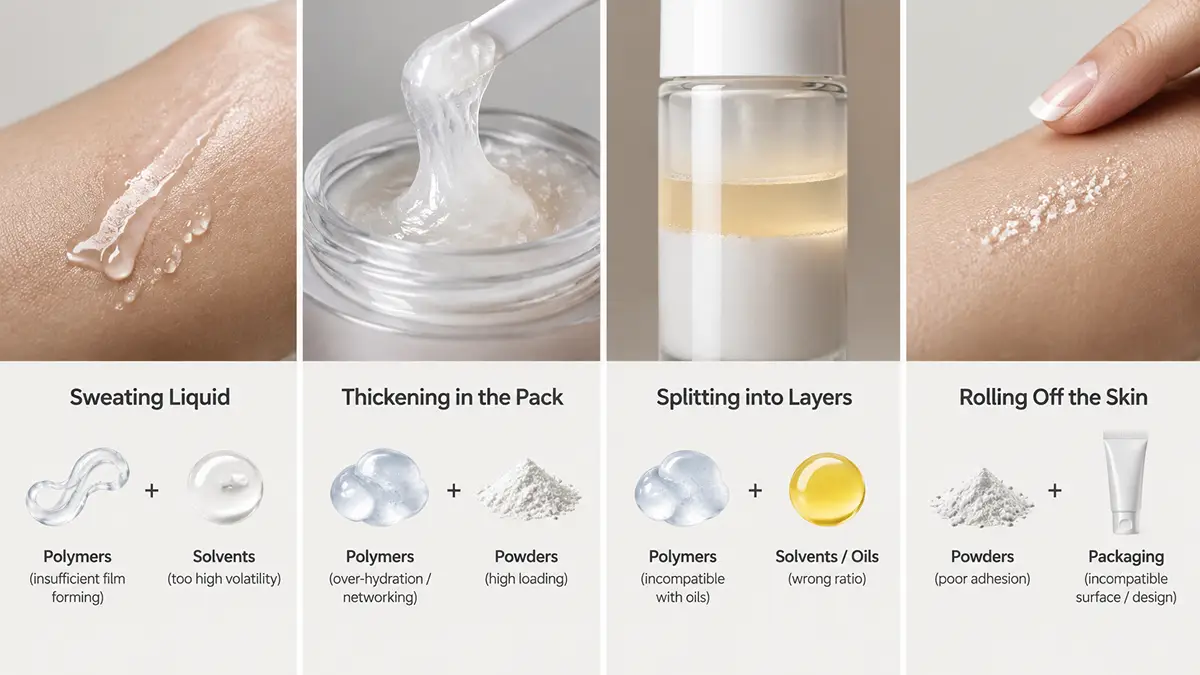
Primer formulas fail in four repeatable ways: sweating liquid, thickening in the pack, splitting into layers, and rolling off the skin. Each one traces to a specific imbalance between polymers, solvents, powders, and packaging.
Syneresis
Syneresis is the gel or cream sweating: liquid squeezes out of its own structure and pools as a watery layer on the surface or clear fluid at the nozzle. Over-structured gel networks contract as they mature. A solvent mix that cannot keep the network swollen does the same. A formula asked to carry more powder than its continuous phase can hold expels liquid as the solids settle.
Correct it at the drawing board: trim the gelling polymer, rebalance the solvent so it swells the network properly, and wet and disperse every powder before you commit the batch. Screening holds at 40–45 °C expose it long before a customer finds it. Lip gloss faces the same mechanism, and our breakdown of lip gloss separation covers the emulsion side in more depth.
Gelling
Gelling is unwanted thickening. The primer turns draggy, hard to spread, or solid in the container months after production. Polymers keep hydrating slowly inside the pack and pull viscosity upward. pH drift can push a thickener into its over-active range. Two thickener systems that behaved in separate beakers can interact once combined.
Prevention is process control rather than ingredient swaps. Hydrate and neutralize polymers fully during manufacture, buffer the pH so it cannot wander, and spread the thickening duty across two agents at lower dose instead of one heavy hitter. A formula that reaches you at the right viscosity and still creeps over eight weeks has a hydration problem, not a dosing problem.
Phase Separation
Phase separation is the formula splitting into visible layers: oil or silicone rising, pigments and fillers packing down at the base. The usual cause is an emulsifier system too weak or wrong for the oil phase it is holding. A continuous phase that is too thin cannot suspend droplets, and powders that were never properly wetted simply sink through it.
Fix it by matching emulsifier type and dose to the specific silicone or oil phase, then rebuilding external-phase viscosity so droplets stay where you put them. Surface-treated powders pay for themselves here, since they disperse into the base instead of fighting it.
Pilling
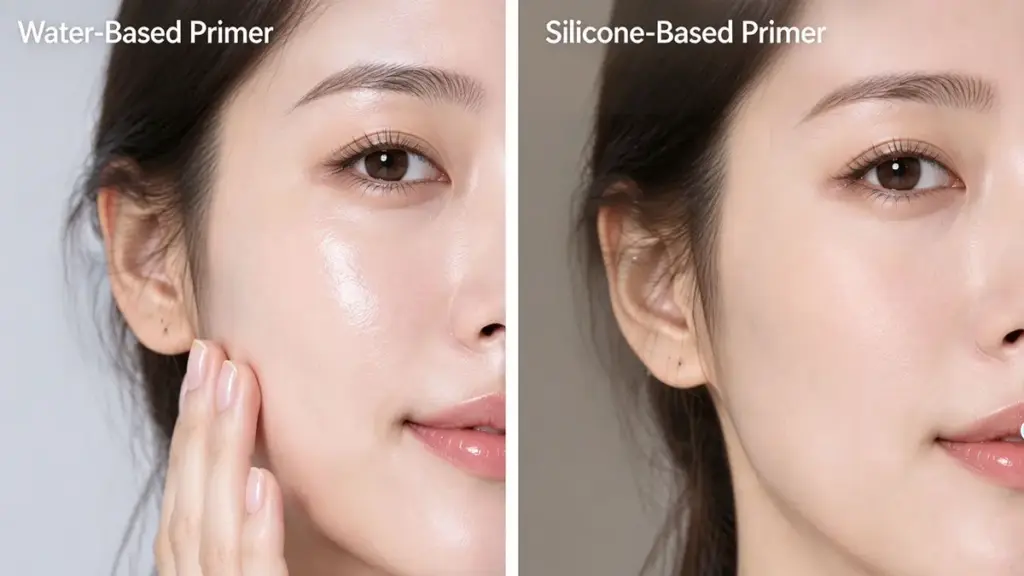
Pilling is the primer rolling into little balls on the skin, usually the moment foundation or sunscreen goes over it. Excess film-forming polymer dries to a brittle sheet that breaks up under friction. Too much powder with too little binder produces the same result, and mismatched layers, a silicone primer under a water-based base, do it without any formula defect at all.
Balance film formers with plasticizers so the film flexes instead of cracking, fix the powder-to-binder ratio, and set drying time with the solvent system. Then test the primer against the bases your customers actually sell, not against a bare forearm.
Scale Your Brand with Stable Primer Formulas.

What Causes Primer Stability Issues?
Three things break a primer down: an unbalanced formula architecture, heat and cold during shipping and storage, and a container that trades chemistry with the product inside it.
Formula Imbalances
Most failures are designed in before the first batch runs.
- An off ratio of oil, water, and emulsifier leaves droplets unprotected, so the formula splits into a watery or curdled texture.
- A weak polymer or thickener network gives pigments nothing to hang on to. They settle, and gel systems expel clear liquid.
- Too many volatile ingredients, certain cyclomethicone grades or short-chain alcohols, creep out of the pack over shelf life. What stays behind thickens, crusts at the nozzle, and drags on skin.
Temperature Changes
Primers are sensitive systems, and the supply chain is where most of that sensitivity gets tested.
- Heat lowers viscosity and speeds droplet collisions, so creaming and coalescence arrive weeks earlier than they would on a climate-controlled shelf.
- Cold crystallizes certain oils and waxes, which reads as graininess or lumpiness once the pack warms back up.
- Repeated cycling does the real damage. Expansion and contraction stress the internal structure until the emulsion breaks for good, and the batch looks fine in the factory.
Packaging Compatibility
The container is part of the formula. The Cosmetics Europe guideline puts it plainly: consider the impact of packaging on the contained product, and the effect of the product on the packaging.
- Tube walls can absorb oils and silicones, or leach moulding residues into the primer. Either shift alters texture and performance.
- A weak barrier lets volatile carriers escape and oxygen in, so the product dries out, thickens, or oxidizes on the shelf.
- Some silicone blends swell a pump gasket. The seal fails quietly, air gets in, and the formula breaks in a way that looks like a batching error.
How Manufacturers Improve Primer Stability
Stability is engineered on three fronts: balancing the formula, holding the emulsion through process control, and screening every ingredient and pack component.
Serious formulators work the structure first. They pick an emulsifier blend by required HLB (Hydrophile-Lipophile Balance) rather than habit, then set the rheology so the continuous phase can physically carry the solid load it is given. High-shear homogenization decides droplet size, and droplet size decides how fast separation can happen.
Process discipline is the second lever and the one factories cut first when schedules tighten. Addition order, temperature at the phase-blend step, and cooling rate all leave fingerprints on the finished texture. A formula that passes in a 500 g beaker and fails in a 500 kg tank almost always has a process problem, not a recipe problem.
| Formula Optimization | Emulsion Stabilization | Compatibility Testing |
|---|---|---|
| Oil-to-water ratio and solids loading set suspension limits. | Emulsifier blends chosen by required HLB coat each droplet. | Silicones, oils, polymers and pigments screened in pairs. |
| Rheology modifiers control viscosity, feel and drip resistance. | High-shear homogenization fixes droplet size and creaming rate. | Accelerated holds, cycling and centrifuge force weak points early. |
| pH and electrolytes sit inside the thickener and preservative window. | Network builders in the water phase block droplet merging. | Actives, preservatives and fragrance checked against the base. |
| Oxidatively stable oils and antioxidants protect color and odor. | Addition order, blend temperature and cooling rate stay locked. | Final tube or pump validated, not a beaker. |
What Stability Data to Request from Suppliers
Ask for the study protocol, the stress-test records, and the shelf-life basis in writing. Anything a factory will not document has not been tested.
Brands often accept a passing shelf sample and assume the formula is stable. The sample proves only that the beaker worked. What protects a launch is paper that maps to the four stability duties in the Cosmetics Europe stability guideline.
The Stability Study Report
Request the protocol and the results: storage temperatures, hold times, test points, and the attribute checks at each point. Accelerated work is commonly run at 37 °C, 40 °C or 45 °C for one to three months. Temperature and duration follow the product type, not a template. Appearance, odor, viscosity, pH and spreadability should be recorded, not eyeballed at the end.
Stress and Cycling Records
Temperature cycling and freeze-thaw reveal flaws faster than constant-temperature storage, and the guideline is candid that freeze-thaw suits some product types rather than all of them. For a water-based primer shipping through a cold market in January, cycling is the test that matters. Commercial lab protocols often run three cycles at roughly −10 °C for 24 hours followed by thawing at room temperature. The method detail lives in our lip gloss stability testing guide, so read that once and reuse the same questions for primer.
Shelf-Life and Labeling Basis
Push back when a supplier offers a shelf life with no reasoning behind it. The same guideline states that little published research supports blanket accelerated methods for predicting cosmetic shelf life, so a credible number rests on your own real-time data plus stress results. EU labeling then turns that number into a duty. Formulas estimated below 30 months of durability print a minimum durability date; longer-lived ones carry the PAO (Period After Opening) symbol instead.
How to Choose a Stable Primer Formula

Pick the formula architecture that matches the claim you intend to sell, then prove stability in the final pack. A matte primer built on a silicone system and a hydrating gel primer are different stability problems wearing the same product name.
Define What Stable Means for Your Claim
Write the limits down before the lab starts. Physical stability means no separation, no viscosity drift, no syneresis. Chemical stability means no oxidation, off-odor, or color shift. Microbiological stability means the preserved system holds to the last use. Sensory stability means slip, drying time and finish match the approved sample at month nine, not only at day one.
- Match the archetype to the claim. Our face primer line runs six types, hydrating, matte, tinted, illuminating, color-correcting and oil-control, and each one carries a different failure profile.
- Silicone-based systems suit mattifying and long-wear claims and tolerate temperature swings well. Aqueous gel systems suit hydrating claims and are simpler to keep stable, but they fear freezing.
- Do not chase two claims from one architecture. Pushing a dewy, hydrating benefit out of a matte system is where primer texture stability problems start.
- Choose ingredients with a track record: oxidatively stable oils, inert silicones, and film formers known to play with your chosen base.
Validate the Formula Before You Commit a PO
Set the specification first: acceptable ranges for appearance, viscosity, pH and shelf life, agreed before testing rather than negotiated after results arrive. Then stress the formula. Hold it hot, cycle it cold, and spin it in a centrifuge to force the weaknesses out early.
Run the pack into the stress protocol. A primer can be perfect in glass and useless in a tube. Confirm the formula does not crack or swell the container, and that the container does not pull volatile carriers out of the formula. The water phase deserves attention too: deionised water keeps ionic strength predictable, and thickener systems work inside a window. Carbomer-based gels, the common first-mention example, build optimum viscosity once neutralised at around pH 5.5–7, and preservative choice follows the same pH. If you are also specifying grip primer production, that pH window is where tack and clarity are won or lost.
Verify performance after the stress, not only appearance. Spread feel, dry-down time, and how well foundation holds over the primer are the attributes your reviews will be judged on.
Frequently Asked Questions
What are the common primer texture stability problems?
Four show up most often: syneresis, gelling, phase separation and pilling. The first three are shelf failures, visible as a watery layer, thickened product, or split layers. Pilling appears only on skin, when the film rolls into small balls under foundation or sunscreen.
Why does my primer squeeze out clear liquid first?
That is syneresis or early phase separation. Liquid migrates to the lowest-resistance point, which is the nozzle, so it exits before the thicker product. Kneading the tube remixes it temporarily. A batch that needs this every morning has a formula problem shaking will not solve.
What makes a silicone primer turn clumpy in the pack?
Three causes dominate: silicone polymers continuing to crosslink slowly in the container, loss of volatile carriers through a weak barrier, and fillers or pigments agglomerating once the wetting balance shifts. Storage heat accelerates all three, so the lot that left the factory fine arrives thick.
How does temperature shock affect a water-based primer?
Heat drops viscosity and speeds droplet collisions, so separation arrives sooner. Freezing forms ice crystals that puncture the emulsion, leaving a grainy or watery texture that will not re-homogenize with stirring. Winter shipping and a hot car are the two usual culprits.
Can the tube itself destabilise a primer?
Yes, and this is why stability belongs to the packaging decision. Tube walls absorb silicones or oils, thin barriers let vapour out and oxygen in, and some formulas swell a pump gasket until the seal fails.
How long should a primer hold its texture?
For the whole declared shelf life, and EU labeling turns that number into a visible duty. Formulas estimated under 30 months of durability print a minimum durability date, while longer-lived ones carry the PAO symbol. Whatever figure your factory claims, ask for the data behind it.
Reflexiones finales
Primer texture stability is a specification, not a hope. Define the four duties, choose the architecture that fits your claim, and make every supplier document the accelerated holds, cycling records, and pack-compatibility work that support their numbers.
Request stability-tested samples and run your own limits into the report before you commit a purchase order. Talk to our formulation team about the primer specification your market demands, and we will build the documentation set alongside the formula.