
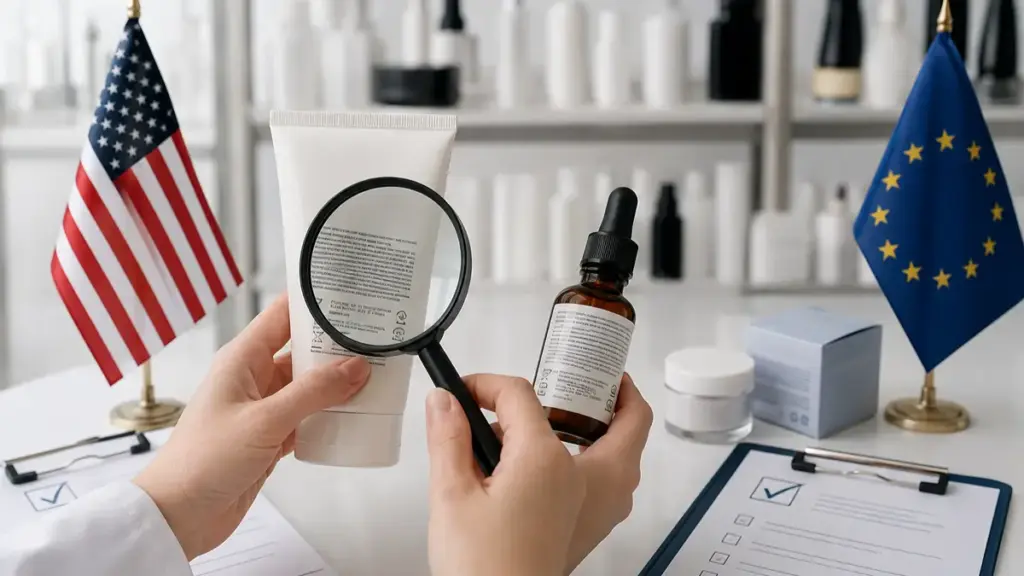
Cosmetic labeling mistakes can lead to products being considered misbranded in the U.S. and can create serious market-access problems in the EU. For brands selling in both markets, labels need to meet different requirements for ingredients, net content, responsible-party information, warnings, and product claims.
The U.S. and EU take different approaches to cosmetic compliance. In the U.S., MoCRA introduced requirements for facility registration, product listing, safety substantiation, and serious adverse event reporting. In the EU, compliance centers on a safety assessment, a Cosmetic Product Safety Report (CPSR), a Responsible Person, and pre-market CPNP notification. Labeling requirements also differ between the two markets.
Why Cosmetic Compliance Matters
Cosmetic compliance protects consumers and helps brands avoid regulatory problems that can disrupt sales, recalls, and distribution. Clear, accurate labeling also gives retailers and customers more confidence in the products they buy.
Ensuring Consumer Safety and Avoiding Enforcement Actions
The entire framework of FDA regulation exists to keep consumers safe. Failing to meet these standards isn’t just bad practice; it exposes your business to significant legal and financial risk. MoCRA has added several new federal requirements for U.S. cosmetics, including facility registration, product listing, safety substantiation records, and serious adverse event reporting, although certain small-business exemptions apply.
- Consumer Protection: FDA rules aim to prevent harm from unsafe ingredients, product contamination, and misleading or incomplete labels. This is the primary goal of the entire system.
- Enforcement Consequences: Noncompliance can trigger serious actions from regulators. This includes FDA warning letters, mandatory product recalls, significant fines, and other legal penalties that can halt operations.
- The Drug-Claim Trap: If your marketing language suggests a product can treat, cure, or prevent a condition, the FDA may classify it as a drug. This subjects the product to much stricter regulations and increases legal exposure.
- MoCRA’s New Mandates: The Modernization of Cosmetics Regulation Act created new legal duties. Companies must now register their manufacturing facilities, list every product on the market, provide robust safety substantiation, and report serious adverse events to the FDA.
Protecting Brand Trust and Market Access
Beyond avoiding penalties, a solid compliance record is a business asset. It signals to partners, retailers, and customers that your brand is reliable and operates with integrity. In a crowded market, this trust is a critical differentiator that unlocks growth opportunities.
- Supply Chain Confidence: A clean compliance history builds trust with retailers, distributors, and logistics partners. This makes it easier to get your products on shelves and ensures smoother operations from factory to storefront.
- Reputation Management: Adhering to regulations helps prevent the kind of public safety issues and product recalls that can permanently damage a brand’s reputation and destroy consumer trust overnight.
- Foundation for Growth: Compliance is a growth enabler. It provides a stable foundation that allows brands to scale operations and expand into new markets with substantially lower risk.
- Customer Loyalty: Accurate labeling and properly substantiated safety data show a commitment to transparency. This reinforces customer confidence and builds the kind of long-term loyalty that is difficult for competitors to break.
FDA Cosmetic Requirements
FDA regulates cosmetics through rules on ingredient safety, product registration, and labeling. MoCRA introduced stricter mandates for safety records, facility registration, and adverse event reporting.
Ingredient Safety
Cosmetic companies are responsible for ensuring the safety of their products. Under MoCRA, the responsible person must maintain records supporting adequate safety substantiation. FDA does not prescribe one specific set of safety tests for every cosmetic product or ingredient, so the safety information needed depends on the product and the available evidence. The FDA doesn’t pre-approve most ingredients, but it does prohibit or restrict certain substances. All color additives, for example, must be pre-approved for their specific use in cosmetics.
The Modernization of Cosmetics Regulation Act (MoCRA) made this responsibility more explicit. Businesses now have to maintain detailed records that back up their safety claims. If a serious adverse event happens, like a significant allergic reaction or injury, the company must report it to the FDA within 15 business days. As a result, brands need a reliable process for documenting and reviewing customer complaints so that serious adverse events can be identified and reported on time.
Facility Registration and Product Listing
Under MoCRA, applicable facilities that manufacture or process cosmetics for the U.S. market must register with the FDA and renew their registration every two years. This requirement applies to qualifying facilities in the U.S. and abroad, although certain small-business exemptions may apply. Facility registration information must also be updated when required changes occur.
The responsible person must list each marketed cosmetic product with the FDA, including its ingredients, and provide updates annually. Facility registration and product listing are separate requirements, and neither one constitutes FDA approval of the cosmetic product.
Labeling Rules
Cosmetic labels have to be clear and accurate. The basics include the product’s identity (like “shampoo”), the net quantity of contents, the manufacturer’s details, and instructions for safe use. All this information must be prominently displayed and easy for a consumer to read.
The ingredient list has its own set of rules. Ingredients must be listed in descending order by weight, using their common or established names, often the INCI (International Nomenclature of Cosmetic Ingredients) names. Looking ahead, MoCRA will also require companies to disclose specific fragrance allergens directly on the product label once the final rule is issued.
Build Your Brand with High-Performance Mascara
EU Cosmetic Regulations
Selling cosmetics in the EU requires a formal safety report (CPSR), a legally liable EU-based Responsible Person, and a central product notification (CPNP) for market surveillance.
Cosmetic Product Safety Report
Before a cosmetic product is placed on the EU market, it must undergo a safety assessment and have a Cosmetic Product Safety Report (CPSR) prepared in accordance with EU cosmetic regulations. The CPSR is divided into two parts. Part A contains the product safety information needed for the assessment, including the formula, physical and chemical characteristics, stability, microbiological quality, packaging information, and toxicological information on the ingredients. Part B contains the safety assessment and the reasoning behind the assessor’s conclusion, together with the required warnings and the safety assessor’s credentials. The assessment must be carried out by a qualified safety assessor with appropriate university-level qualifications in pharmacy, toxicology, medicine, or a similar discipline. The Responsible Person must keep the Product Information File (PIF), which includes the CPSR, readily accessible for at least 10 years after the last batch of the product is placed on the market and ensure the safety report is updated when relevant new information becomes available.
Responsible Person
Every cosmetic product must have a designated Responsible Person (RP) located within the EU. The Responsible Person (RP) is the party legally responsible for ensuring that the cosmetic product complies with Regulation (EC) No 1223/2009. The RP must, among other duties, maintain the Product Information File (PIF), ensure that the product has undergone the required safety assessment, and handle required reporting and regulatory obligations.The RP’s name and address must appear on the product label, allowing consumers and authorities to identify the party responsible for the product in the EU. The RP’s name and EU address must be printed clearly on the product label. This tells everyone, from consumers to regulators, exactly who is on the hook for that product’s safety.
CPNP Registration
Before you can place a product on the market, the Responsible Person must notify it through the Cosmetic Products Notification Portal (CPNP). This is a central online system for the entire EU. Its purpose is to give competent authorities and poison control centers quick access to key information for market surveillance and for handling medical emergencies. The notification includes the product category, RP details, formulation data, and a copy of the label. It’s important to understand this is a pre-market notification, not a product approval. Registering on the CPNP doesn’t mean the product is “EU-approved.” The full legal liability for safety and compliance stays with the Responsible Person.
EU Cosmetic Labeling Requirements
EU cosmetic labels must include specific information before a product is placed on the market. Under Article 19 of Regulation (EC) No 1223/2009, the container and packaging must carry the required information in a legible, visible, and indelible form.
The required information includes the name and address of the EU Responsible Person, the country of origin for imported products, nominal content, durability information, applicable precautions, the batch number or product reference, the product function where it is not obvious, and the ingredient list. The ingredient list must use the required cosmetic ingredient names and generally follow the descending order of weight at the time the ingredients are added to the product. Ingredients present at less than 1% may be listed in any order after those present at more than 1%. For decorative cosmetics sold in several colour shades, certain colorants may be listed using “may contain” or “+/-” where permitted.
The label must also provide the required information in the language or languages required by the EU member state where the product is made available. Certain information, such as precautions for use and product function, may therefore need to be adapted for the target market.
For products with a durability of more than 30 months, the Period After Opening (PAO) symbol is generally used to indicate how long the product can be used safely after opening. Where the minimum durability is 30 months or less, the date of minimum durability must be indicated instead, subject to the applicable rules.
Because EU labeling requirements apply to both the product formula and the way the finished product is presented to consumers, the final packaging artwork should be checked against the product information and the target market requirements before production.
Cosmetic Labeling Requirements
Cosmetic labels serve both a marketing and a legal function. Errors in ingredient declarations, net contents, business information, warnings, or claims can result in a product being considered misbranded and may lead to regulatory action.
U.S. cosmetic labeling is governed by the Federal Food, Drug, and Cosmetic (FD&C) Act, the Fair Packaging and Labeling Act (FPLA), and the Modernization of Cosmetics Regulation Act (MoCRA). These regulations set strict, non-negotiable rules for what must appear on your product. Failure to comply can get your product classified as “misbranded,” leading to serious operational and legal headaches.
Here’s a breakdown of the four core components every cosmetic label must get right.
| Labeling Element | Key Requirements |
|---|---|
| Ingredient Lists | A full declaration is required, with ingredients listed by weight in descending order using INCI names. Ingredients under 1% can be listed in any order at the end. Fragrance allergens must be listed once MoCRA rules are finalized. |
| Net Content | The net quantity must be accurately stated in the required U.S. customary units and placed in the required area of the principal display panel. A metric declaration may also be included. |
| Manufacturer Information | The label must state the name and address of the manufacturer, packer, or distributor. MoCRA also mandates a U.S. contact (phone, address, or electronic) for reporting adverse events. |
| Warnings and Claims | All necessary warnings for safe use are mandatory. All performance claims (e.g., “hydrating”) must be truthful and substantiated. Claims cannot classify the product as a drug by suggesting it treats or cures disease. |
Ingredient Lists
This is a non-negotiable transparency requirement. Every cosmetic must have a full ingredient declaration. The rules for this list are specific:
- Order Matters: Ingredients generally must be listed in descending order of predominance by weight. Ingredients present at 1% or less may be listed in any order after those above 1%, while color additives are subject to separate ordering rules.
- Use Standard Names: You must use the standardized International Nomenclature of Cosmetic Ingredients (INCI) names.
- The 1% Rule: Any ingredient with a concentration of 1% or less can be listed in any order after all the ingredients present at more than 1%.
- Future Allergen Disclosure: MoCRA requires FDA to establish fragrance allergen labeling requirements. Brands should monitor FDA rulemaking and review fragrance-related labeling once the applicable final requirements take effect.
Net Content
The net quantity of contents tells the consumer exactly how much product they are buying. Its placement and format are mandated. It must be displayed on the principal display panel—the front of the package—and located within the bottom 30% of that panel. For cosmetics sold in the U.S., the net quantity must be stated using the required U.S. customary units. A metric declaration may also be included. The statement must appear in the required area of the principal display panel and accurately reflect the amount of product in the package. Overstating the amount of product is a clear violation and can lead to a misbranding charge.
Manufacturer Information
Consumers and regulators need to know who is responsible for the product. The label must clearly state the name and business address of the manufacturer, packer, or distributor. If the name on the label is for the distributor and not the actual manufacturer, the relationship should be clarified with phrases like “Distributed by.” MoCRA added a critical consumer safety layer: the label must now provide a U.S. domestic address, phone number, or electronic contact so consumers can report adverse events.
Warnings and Claims
This part of the label serves two functions: ensuring safety and preventing deception. First, labels must include any warnings and clear directions needed for the consumer to use the product safely. Omitting a necessary warning is a serious compliance failure. Second, any claim you make must be truthful, non-misleading, and backed by evidence. Claims such as “hydrating” should be truthful and supported by appropriate evidence. In the EU, cosmetic claims must be supported by adequate and verifiable evidence, with the level of substantiation appropriate to the claim being made. These claims must also stay strictly within the cosmetic category. In the U.S., claims that indicate a product is intended to treat or prevent disease, or affect the structure or function of the body, may cause the product to be regulated as a drug depending on its intended use.
FDA vs EU Cosmetic Labeling Requirements
Although both markets require accurate and complete cosmetic labeling, the information required on the final package is not identical. Brands selling in both markets should review the artwork separately rather than assuming that a label compliant in one market will automatically meet the requirements of the other.
| Labeling Element | U.S. Requirements | EU Requirements |
|---|---|---|
| Responsible Party / Business Information | The label must identify the manufacturer, packer, or distributor by name and place of business. | The label must include the name and address of the EU Responsible Person. |
| Net Quantity | The net quantity must be stated in the required U.S. customary units and placed in the required area of the principal display panel. A metric declaration may also be included. | The nominal content must be stated by weight or volume as required under EU rules. |
| Ingredients | Ingredients must generally be declared in descending order of predominance by weight, with specific rules for ingredients at 1% or less and color additives. | Ingredients must be listed using the required cosmetic ingredient names and generally follow the required order under EU rules. |
| Country of Origin | Imported products are subject to applicable U.S. country-of-origin labeling requirements. | The country of origin must be indicated for imported cosmetic products. |
| Durability / PAO | U.S. cosmetic labeling does not use the EU-style PAO system as a general mandatory element. | Products generally require a date of minimum durability or, where applicable, a Period After Opening (PAO) indication. |
| Warnings and Precautions | Required warnings and directions must appear where necessary for safe use. | Applicable precautions for use must be provided, with required information presented in the languages required by the target EU market. |
| Product Function | The product identity must be stated when required to communicate what the product is. | The function of the cosmetic product must be indicated where it is not obvious from the presentation. |
| Claims | Claims must be truthful and not misleading. Claims that imply treatment or prevention of disease may cause a product to be regulated as a drug depending on its intended use. | Cosmetic claims must comply with EU claim requirements and be supported by adequate and verifiable evidence. |
The biggest practical difference is that a single packaging design cannot always be used unchanged across both markets. Before printing, brands should verify the final formula, ingredient list, mandatory label information, claims, and packaging artwork against the requirements of the specific market.
Common Cosmetic Labeling Mistakes Brands Make
Labeling compliance needs to be reviewed whenever a formula, package, market, or claim changes. A label that works for one product or market may not meet the requirements of another, so brands should check the final artwork against the applicable regulations before production.
Using the Same Label for Different Markets
One of the most common mistakes is assuming that a label designed for one market can be used unchanged in another. The U.S. and EU have different requirements for business information, net quantity, responsible-party details, warnings, and other mandatory label elements.
- Reusing U.S. artwork for EU products without adding the required EU Responsible Person information.
- Failing to include the country of origin when required for cosmetics imported into the EU.
- Using the same net quantity format without checking the measurement and placement requirements for the target market.
- Translating required information incompletely or failing to meet applicable local language requirements.
Missing or Incorrect Product Information
Labeling problems can also occur when required information is missing, outdated, or inconsistent with the actual product. Formula changes should trigger a review of the ingredient declaration and other affected packaging information before new artwork is approved.
- Listing ingredients under incorrect names or in an incorrect order.
- Using an ingredient list that does not match the final formula.
- Omitting required warnings, precautions, batch information, or product function information where applicable.
- Using outdated manufacturer, distributor, or Responsible Person information.
- Failing to update packaging when a formula or regulatory requirement changes.
Making Claims Without Adequate Support
Product claims can create another compliance risk, particularly when marketing language goes beyond what the formula and supporting evidence can substantiate. Claims should be reviewed before they are added to packaging, websites, or other marketing materials.
- Making performance claims that are not supported by appropriate evidence.
- Using wording that could make a cosmetic appear to treat, cure, or prevent a disease in the U.S.
- Making claims on the label that are broader than the product’s intended cosmetic function.
- Assuming that a claim accepted in one market will automatically be acceptable in another.
How Cosmetic Manufacturers Support Label Compliance
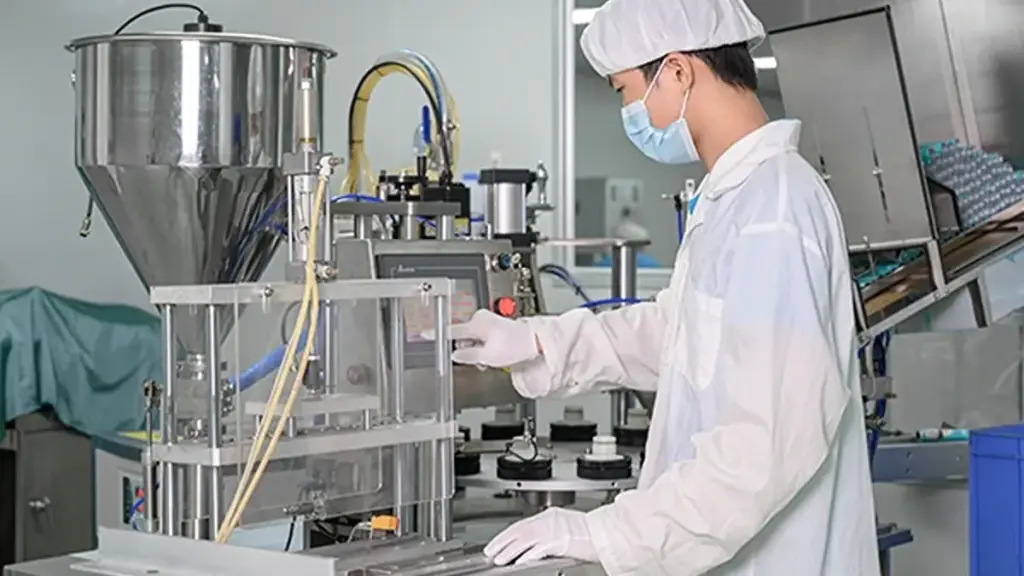
A cosmetic manufacturer can help reduce labeling errors by keeping formula information, packaging specifications, artwork, sampling, and production records aligned throughout product development. This is particularly important for private label and OEM projects, where changes made during development can affect the final label.
Manufacturers don’t just react to regulations; they build systematic controls to manage them proactively. This isn’t about ticking boxes. It’s about integrating compliance into the core operating system of the business, covering everything from safety and quality to environmental impact. The approach is split into two main functions: building the initial framework and then keeping it sharp through active oversight.
Integrating Label Checks Into Product Development
Manufacturers can reduce labeling errors by including regulatory checks in the product development process rather than reviewing packaging only after production is scheduled.
- Confirm the final formula and ingredient information before the ingredient list is prepared.
- Check packaging artwork against the applicable U.S. or EU labeling requirements.
- Review product claims and required warnings before artwork approval.
- Keep the approved formula, packaging specifications, artwork, and sample version aligned throughout production.
Coordinating Formula, Packaging, and Production
Label compliance starts before the packaging artwork reaches the production line. A cosmetic manufacturer needs accurate formula information, packaging specifications, and approved artwork to stay aligned throughout development and production. For private label and OEM projects, this coordination is especially important because changes to the formula or packaging can affect the information shown on the finished product.
Silorán supports customized cosmetic production through a process that includes formulation design, formulation review, packaging design, sample testing, customer confirmation, and mass production. Its R&D team works alongside dedicated production departments for daily chemical, lip makeup, powder, and spraying products. The factory also uses automated filling, capping, packaging, and color-filling equipment, while production takes place under a GMP 100,000-grade clean-room standard with quality testing procedures. This integrated workflow helps brands keep product specifications and packaging details aligned as a product moves from development to finished production.
Related posts:
- How to Ensure Quality of Cosmetics Manufacturing: Key Steps and Best Practices
- Cómo encontrar un fabricante de cosméticos en 7 pasos
- ¿Qué son los cosméticos de marca blanca? Guía básica
Maintaining Active Oversight and Improvement
A documented compliance process should translate regulatory requirements into clear steps for product development, formula review, packaging artwork, labeling checks, and record-keeping.
- Conduct regular internal audits and inspections to monitor performance and prepare for external reviews.
- Investigate any non-compliance to identify root causes and implement corrective actions that feed into a continuous improvement loop.
- Extend compliance controls to vendors and suppliers to ensure materials and outsourced processes meet all standards.
- Use compliance management systems and technology to streamline tracking, reporting, and accountability across the organization.
Frequently Asked Questions
What safety testing is typically used for mascara?
There is no single test package required for every máscara in every market. Depending on the formula and intended use, manufacturers may use microbiological testing, stability testing, preservative efficacy testing, packaging compatibility testing, and other safety data as part of a broader mascara quality control process. For EU products, the relevant safety information must support the CPSR and its scientific safety assessment.
How should a private label mascara be labeled for sale in the EU?
EU cosmetic labeling requires the name and address of an EU-based ‘Responsible Person,’ the country of origin (if made outside the EU), net quantity, a full ingredient list using INCI names, a batch number, and a Period After Opening (PAO) symbol indicating its usable life after opening (e.g., ‘6M’). Any warnings must be in the local language, and all marketing claims must be supported by evidence.
Does a finished cosmetic product like mascara require an SDS?
A finished cosmetic product is not automatically subject to the same SDS requirements as industrial chemicals simply because it is a cosmetic. SDS obligations depend on the applicable chemical and workplace-safety rules and the classification of the substance or mixture. Raw-material suppliers may provide SDSs for ingredients or mixtures where required, and these documents can also be useful during manufacturing and safety assessment.
Are any ingredients banned or restricted in mascara?
Yes. Ingredient restrictions vary by market, and a substance that is permitted in one country may be prohibited or restricted in another. Color additives are also subject to specific requirements, particularly in the U.S. and EU. Before launch, the formula should be reviewed against the current ingredient restrictions that apply to the target market.
How is a new cosmetic product listed in the U.S. and EU?
In the U.S., applicable facilities must register with FDA, and the responsible person must submit a cosmetic product listing and update it annually. In the EU, the responsible person must ensure that the product has the required safety assessment and CPSR and must notify the product through the CPNP before placing it on the market. Neither process should be treated as a government approval of the cosmetic itself.
Reflexiones finales
U.S. and EU cosmetic labeling requirements differ in several important areas, so brands should review their formula, packaging, claims, and mandatory label information for each target market. A structured review before production can help identify labeling issues before products reach retailers or consumers.
Don’t guess on your market access strategy. We recommend a full compliance audit to map these regulatory frameworks directly onto your product line. Contacte con nuestro equipo to ensure your labels are commercially ready for your target market.