

Understanding how lip gloss stability testing works prevents common product failures like oil separation, texture graininess, and microbial contamination. Without robust testing, brands risk failed regulatory submissions, costly returns, and reputation damage.
This guide details the technical benchmarks for validating a 30-month commercial shelf life. We cover accelerated testing at 45°C, freeze-thaw cycling, and packaging compatibility—providing the data required to meet FDA and EU cosmetic regulations.
Why Stability Testing Is Important
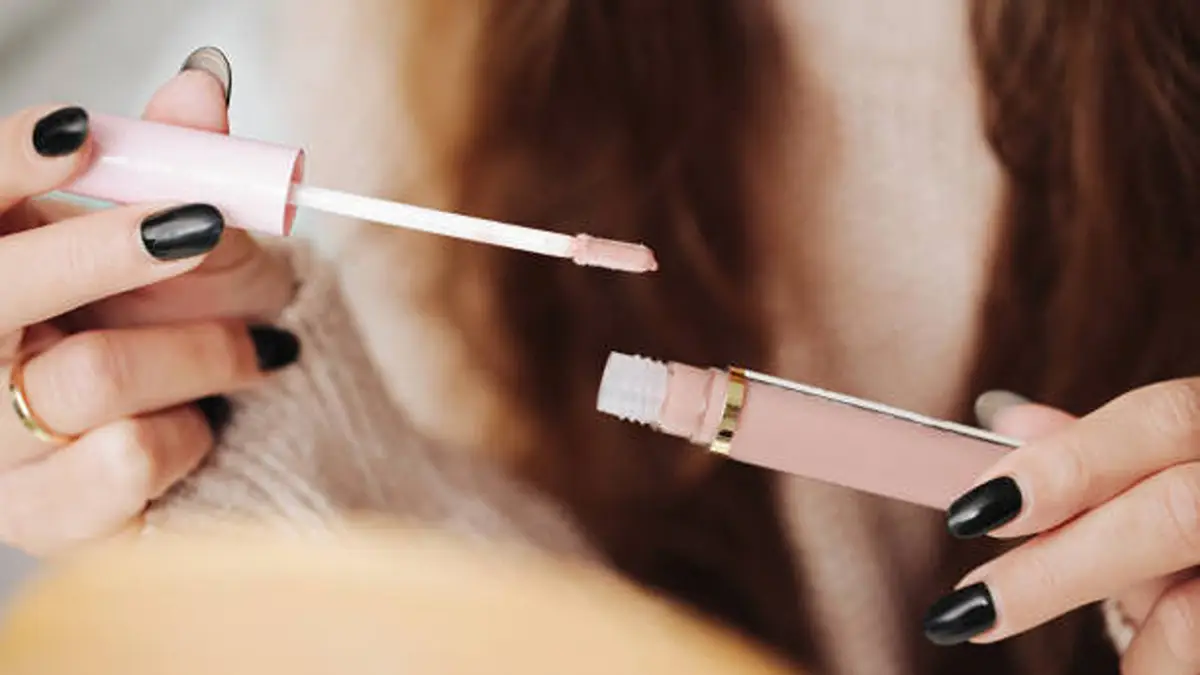
Stability testing verifies a lip gloss is safe, performs correctly, and won’t fail in its packaging—an essential step protecting consumers and brand reputation.
For brands selling through wholesale channels or launching private label lines, stability data isn’t optional—it’s the foundation of regulatory compliance and buyer confidence. Retailers in the EU, US, and Southeast Asia increasingly require documented proof that products meet shelf-life claims before listing them.
Ensuring Product Safety and Quality
The primary purpose is confirming the product won’t become harmful or unusable over its intended lifespan. This gives brands data to defend shelf-life claims and protect end consumers. A brillant à lèvres that separates, develops rancid odors, or grows mold doesn’t just disappoint—it triggers returns, chargebacks, and potential regulatory action.
- Confirms the lip gloss remains safe by checking for harmful chemical changes or microbial issues over time.
- Maintains the intended sensory experience by verifying color, texture, gloss, and scent don’t degrade.
- Establishes reliable shelf life, giving consumers confidence in product longevity after purchase.
- Provides documentation retailers and distributors require before committing to bulk orders.
Verifying Formulation and Packaging Integrity
Testing validates that the gloss and container work together from factory to consumer. This is where formulators identify weaknesses before they become costly recalls. A formula that performs perfectly in glass may fail in plastic packaging due to chemical interactions—testing catches these issues before market launch.
- Identifies formula weaknesses like oil-pigment separation or viscosity changes.
- Validates formula-packaging compatibility, preventing leaks, cracks, or chemical interactions.
- Provides data to support label claims and meet regulatory standards, reducing returns and brand damage.
- Reduces the risk of batch-to-batch variation affecting product performance in the field.
What Stability Testing Measures
Stability testing evaluates specific physical, chemical, and microbiological attributes to confirm a lip gloss maintains safety and performance over time.
Rather than a single pass/fail check, stability testing evaluates different failure modes—physical separation, chemical degradation, microbial growth, or packaging interaction.
Core Product Quality and Safety Attributes
Testing focuses on three measurable categories that define whether the formula remains acceptable through expiration. Each category addresses different failure modes that could render the product unsellable or unsafe.
- Physical Properties: Technicians monitor appearance, color, odor, and texture to confirm the gloss won’t separate, discolor, or develop grittiness. For pigmented formulas, color shift is a critical failure point—wax crystallization can cause a once-uniform red gloss to appear streaky or mottled.
- Chemical Integrity: Labs measure ingredient breakdown—pigment stability, oil rancidity, and functional ingredient degradation (UV filters, antioxidants). Oils like castor oil and lanolin derivatives are prone to oxidation, producing off-odors that consumers immediately detect.
- Microbiological Safety: Critical for lip products used near the mouth. Testing verifies the preservative system prevents bacteria, yeast, and mold growth throughout the use cycle. Even high-oil formulas with low water activity face contamination risk from applicator wands introducing moisture.
Packaging Performance and Shelf-Life Determination
A stable formula still fails if its container compromises it. Testing evaluates the complete system—gloss inside final packaging. Different packaging materials present different challenges: plastic tubes may allow volatile fragrance compounds to permeate out, while certain glass formulations can interact with high-pH formulas.
- Container Compatibility: Labs check for plastic leaching, fragrance absorption into container walls, or chemical interactions. Stress-cracking in PET or PP tubes is a common failure when formulas contain high levels of certain esters or solvents.
- Environmental Resistance: Tests simulate shipping and storage—heat, freeze-thaw cycles, light exposure—revealing real-world performance. A lip gloss shipped from a Guangdong factory to a Scandinavian winter faces temperature swings that can trigger phase separation.
- Shelf-Life Justification: All data feeds into expiration date assignment, providing documented proof for claims like “long-lasting shine.” Brands selling to regulated markets (EU, US, Japan) need this documentation for product registration.
Accelerated Stability Testing
Accelerated stability testing uses high heat and temperature cycles to predict long-term shelf life in months, catching potential failures early.
High-Temperature Exposure
Labs expose lip gloss samples to elevated temperatures—typically 45°C (113°F)—to speed up chemical reactions. The Arrhenius equation predicts that reaction rates roughly double for every 10°C increase, so testing at 45°C accelerates degradation by a factor of four to eight compared to room temperature storage. Thermal cycles move product between extreme cold (-10°C) and high heat, simulating shipping temperature shocks.
This forces potential failures to appear quickly, revealing oil separation, syneresis (sweating), color fading, or grainy texture. Catching problems in weeks rather than years is the main advantage. For wax-based formulas, high heat can trigger polymorphic transitions in wax crystals—leading to the dreaded “grainy” texture that consumers find unacceptable.
Long-Term Aging Simulation
Data from short-term intense conditions predicts shelf life over longer durations, allowing formulators to make decisions without waiting two to three years for real-time aging. This is particularly valuable for brands planning seasonal launches or responding to market trends—waiting 24 months to confirm stability isn’t commercially viable.
As a general industry rule, if a formula remains stable for three months at constant 45°C, it typically projects stability for about two years at room temperature. This approximation provides a working basis for expiration dates, though real-time studies should validate it. Some manufacturers use more aggressive conditions (50°C for one month) as an early screening tool, though results from these conditions require more conservative extrapolation.
Appearance Monitoring
Throughout testing, technicians regularly inspect samples for changes in consumer-important attributes. Key parameters monitored include:
- Color, clarity, and signs of fading or yellowing.
- Gloss level and shine consistency.
- Texture—checking for graininess, thickness changes, or syneresis.
- Odor—watching for rancid or off-notes from oil oxidation.
Freeze-Thaw Testing
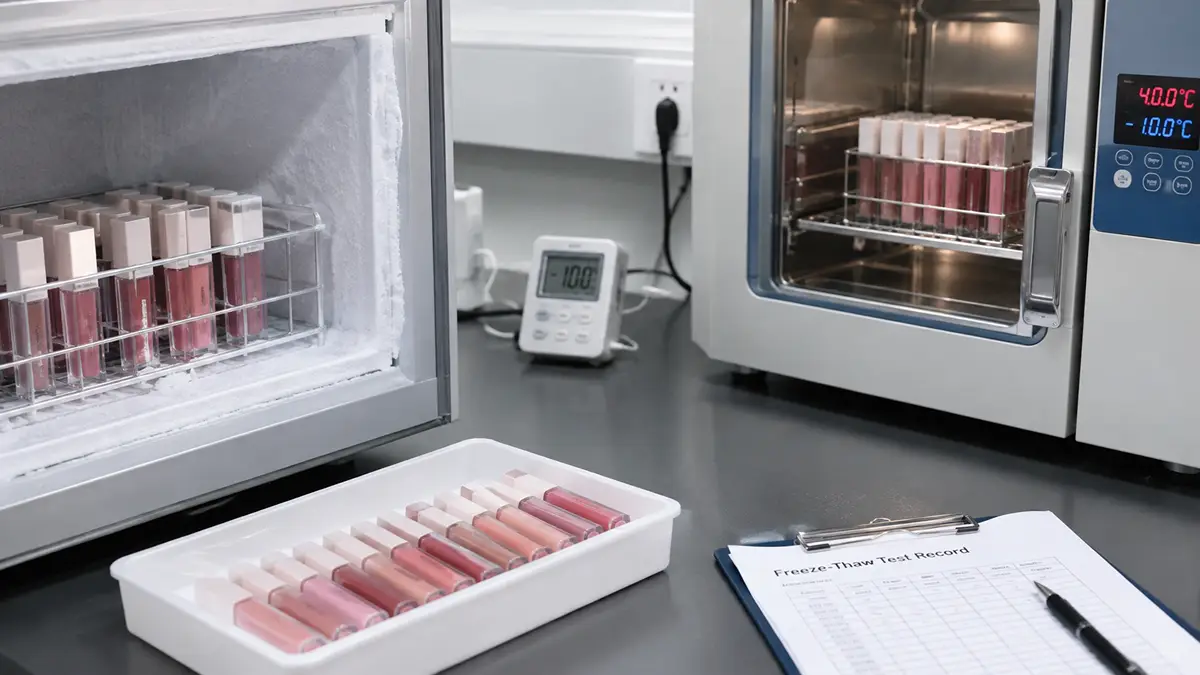
Freeze-thaw testing cycles lip gloss through extreme temperatures to mimic shipping stress, revealing weaknesses like oil separation or texture breakdown.
Temperature Cycling
This test simulates temperature swings during shipping and storage. A standard cycle involves freezing at -10°C (14°F) for 24 hours, then thawing at room temperature (25°C/77°F) for 24 hours.
Some protocols add a heating step—after thawing, product sits at 40-50°C (104-122°F) for 24 additional hours. Running at least three cycles is industry standard, typically enough to screen for long-term instability. Labs test in final packaging, comparing against a room-temperature control.
Separation Evaluation
After temperature cycles, technicians spot physical separation. Signs of instability include:
- Visible oil layers forming on surface or bottom.
- Pigment settling at the container bottom.
- Grainy, lumpy, or stringy texture instead of smooth gloss.
Evaluation compares cycled samples to the control—checking color, clarity, uniformity, viscosity changes, and new odors. A lip gloss passes if it shows no phase separation, significant texture changes, or color shifts after all cycles.
Packaging Compatibility Testing
Compatibility testing confirms lip gloss and its tube won’t ruin each other—preventing chemical reactions, physical failures, and leaks before market launch.
Packaging is part of the product system. Compatibility testing verifies the two coexist without problems over the product’s entire shelf life.
Key Assessment Areas
A thorough compatibility program examines the entire system from multiple angles.
- Chemical Reactions: Labs check for formula leaching plasticizers from tubes, plastic absorbing fragrance, or oils causing stress-cracks in container necks.
- Physical Changes: Both product and package are monitored for degradation—gloss discoloration, separation, or packaging warping, cracking, yellowing.
- Functional Performance: Testing verifies applicators, wipers, and seals work correctly over time without leaking, clogging, or breaking.
- Barrier Performance: Weight measurements assess how well packaging prevents volatile ingredients (solvents, fragrance) from evaporating.
Test Design and Conditions
Tests simulate a product’s entire lifecycle, from factory to customer’s hot car.
- Final Packaging vs. Controls: Product is tested in final retail packaging. A control batch in inert glass isolates formula-only issues from packaging interactions.
- Accelerated Conditions: Samples are stored at elevated temperatures (typically 40-50°C) and high humidity to predict long-term stability in weeks or months.
- Real-Time Studies: Accelerated testing is validated with long-term studies—samples kept at room temperature for the full proposed shelf life (24-36 months).
- Cyclic Stress: Freeze-thaw cycles and light exposure mimic shipping and real-world use, revealing phase stability and packaging integrity weaknesses.
Microbiological Stability Testing
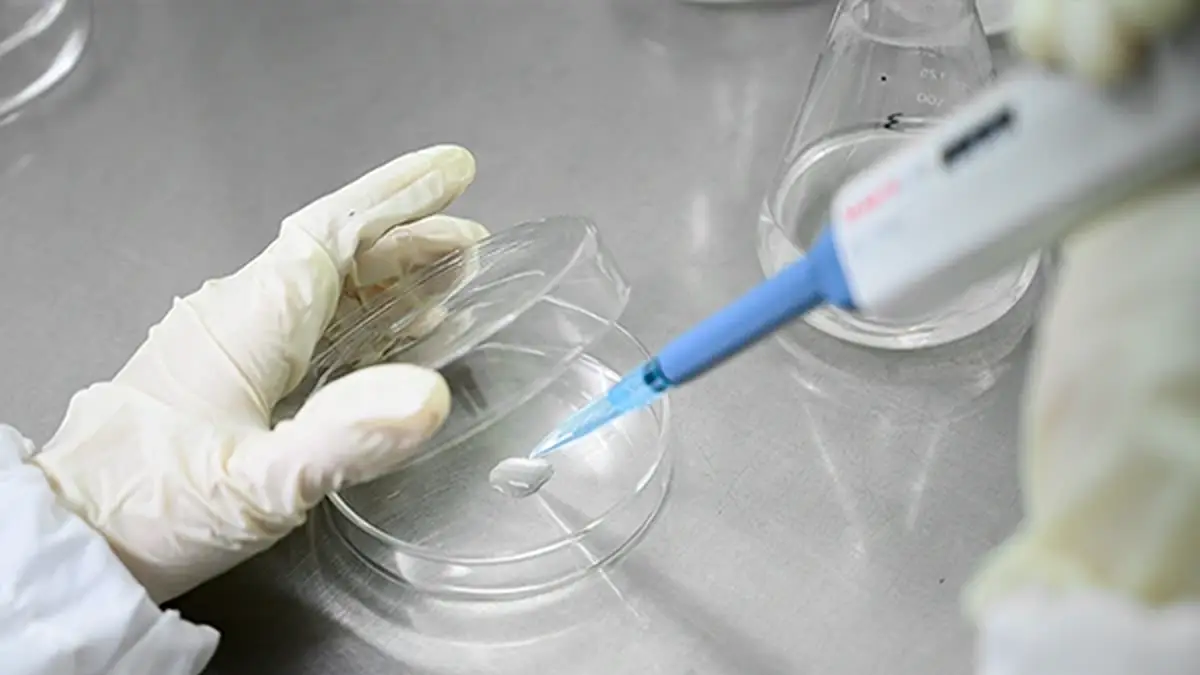
This testing confirms a lip gloss can resist bacteria, yeast, and mold—critical for a product used daily on the lips.
Preservative Effectiveness
This evaluation determines whether the preservative system prevents bacteria, yeast, and mold growth. Contaminants can enter during manufacturing or through consumer use. Common preservatives in lip gloss include phenoxyethanol, parabens, and potassium sorbate—each with different effectiveness profiles depending on the formula’s pH and composition.
The preservative must remain active within the formula’s specific chemical matrix—oils, waxes, pigments, pH, and water activity. This matters even in high-oil or low-water formulas, because applicator moisture can create microbial growth niches. A lip gloss with 5% water activity might seem safe, but repeated wand contact introduces enough moisture to support localized microbial growth if the preservative system is inadequate.
Challenge Testing
Challenge testing (Preservative Efficacy Testing or PET) is direct lab validation. The lab inoculates lip gloss with high concentrations of Staphylococcus aureus, Pseudomonas aeruginosa, or Candida albicans. These organisms represent the most common contamination risks: S. aureus from skin contact, P. aeruginosa from water sources, and C. albicans from yeast naturally present in the environment.
Microbial population is measured at 7, 14, and 28 days to track reduction. The formula passes if it achieves predefined log reduction criteria—typically a 99.9% reduction (3-log) for bacteria within 14 days and no recovery at 28 days. This confirms the preservative system can neutralize contamination throughout shelf life and consumer use. For brands selling in the EU, challenge testing protocols must align with ISO 11930 standards.
UV and Photostability Testing
Photostability testing verifies light exposure won’t degrade color, texture, or active ingredients—ensuring aesthetic quality and SPF claims hold up.
Purpose and Evaluation Criteria
The goal is confirming formula and packaging resist physical and chemical changes under UV and visible light. This is critical for transparent packaging or products making SPF claims. Lip glosses displayed on retail shelves under fluorescent lighting face continuous low-level UV exposure that can degrade pigments and active ingredients over time.
Key parameters include:
- Sensory Integrity: Color, clarity, gloss, texture monitored for fading, yellowing, haziness, or separation. Red and pink pigments are particularly vulnerable to photodegradation, potentially shifting a bright coral shade to dull orange over months of shelf display.
- Active Ingredient Protection: Ensures UV filters, antioxidants, vitamins, and flavors don’t degrade. For lip glosses marketed with SPF 15 or SPF 30 claims, photostability testing confirms the UV filters remain effective throughout the product’s shelf life.
- Claim Substantiation: Provides data proving SPF claims remain accurate throughout shelf life. Regulatory bodies in the US (FDA) and EU require this data before approving sunscreen claims on cosmetic products.
Methodology and Exposure Conditions
The ICH Q1B guideline provides the widely adopted industry standard. Samples are placed in photostability chambers with light sources emitting specific visible and UV spectra. A confirmatory study requires minimum total exposure of:
- Visible Light: ≥ 1.2 million lux·hours
- Near-UV Energy: ≥ 200 watt·hours per square meter (W·h/m²)
“Dark control” samples are stored alongside test samples, completely shielded from light (typically with aluminum foil), isolating light-induced degradation from temperature effects.
How Manufacturers Determine Product Shelf Life
Shelf life is a calculated outcome from predictive stress tests, real-world verification in final packaging, and clearly defined failure criteria.
| Testing Phase | Key Methods and Rationale |
|---|---|
Predictive Testing: Accelerated Stability and Microbial Challenges |
The goal is predicting 24-month shelf life without waiting 24 months. Manufacturers use stress conditions to speed aging and identify weak points. Accelerated Stability Testing stores product under harsh conditions to see what breaks first.
Microbiological Challenge Testing (PET) addresses safety. Even low-water formulas face contamination from applicator wands. Labs add high concentrations of bacteria, yeast, and mold, monitoring preservative performance over weeks. Failed preservative systems mean unsafe products and unjustified shelf life. For more on lip product manufacturing, see how lipstick is made in factory. |
Verification: Packaging, Real-Time Studies, and Failure Criteria |
After predictive tests show promise, focus shifts to confirming results and setting acceptable boundaries. Packaging Compatibility is essential. All stability tests run in final packaging—the exact tube, wand, and wiper sold. Oils and solvents can make plastics brittle, causing cracks. Studies check for leaking seals, flavor absorption, and chemical leaching. Real-Time Stability Studies provide ultimate verification. Production batch samples are stored at room temperature (~25°C) and tested over the full proposed shelf life (24-36 months), confirming accelerated predictions and catching slow-moving issues. Defining Failure Criteria is the final step. Shelf life ends when product no longer meets specifications for:
|
Frequently Asked Questions
How do cosmetics factories run stability tests on lip gloss?
Factories place product samples into stress conditions—high heat (40–45°C), cold temperatures, freeze-thaw cycles, and light exposure. Technicians evaluate samples at regular intervals, checking for color fading, oil separation, gritty texture, rancid odors, or packaging leaks. This data supports shelf-life claims.
What is accelerated stability testing for lip gloss?
Accelerated testing stores samples under stress conditions—primarily high heat (~45°C)—for about three months. This speeds up potential degradation, revealing color shifts or texture changes faster. Passing this test gives formulators confidence the product will remain stable for a couple of years under normal conditions.
Why is a freeze-thaw test needed for cosmetics?
Freeze-thaw tests simulate shipping and storage temperature extremes. Cycling product between freezing (-10°C) and room temperature reveals physical problems—oil separation, grainy texture from wax crystallization, or packaging cracks—that standard heat testing might miss.
How long does cosmetic stability validation take in a lab?
Initial accelerated studies typically take 1-3 months, testing under high heat to predict long-term performance and support 1-2 year shelf-life claims. In parallel, real-time testing runs for the full claimed shelf life (e.g., 24 months) under normal conditions to confirm accelerated predictions.
Do cosmetic factories provide full stability reports for retail approval?
Factories typically don’t provide full stability reports for routine retail approval—these are confidential technical documents. Instead, factories provide a stability summary or formal statement confirming the product passed testing, its approved shelf life, and regulatory compliance. Full reports are available only if specifically negotiated in manufacturing contracts.
Comprehensive stability testing protects brand reputation and meets regulatory requirements. Skipping these steps risks product failures, recalls, and lost consumer trust. If you’re planning a lip gloss line, understanding how to start your own makeup line includes knowing which stability benchmarks your manufacturer should meet.

 French
  English
  Arabic
  Dutch
Dutch  Portuguese
  Russian
  Spanish