

How makeup OEM factories handle color matching plays an important role in preventing batch-to-batch variation and protecting brand consistency. When a shade falls outside the agreed color tolerance, the batch may require adjustment, rework, or rejection, which can increase production costs and delay delivery.
This analysis breaks down the process, from translating a client sample into a digital target in CIE L*a*b* color space to defining strict Delta E (ΔE) tolerances. We explain how spectrophotometers can help characterize an approved master standard, creating a measurable benchmark for future production runs.
Why Color Consistency Matters in Cosmetics
In cosmetics, consistent color protects brand identity, builds consumer trust, and prevents costly manufacturing errors. It’s a direct indicator of quality control and operational discipline.
Protecting Brand Identity and Consumer Trust
A brand’s signature shade is a critical asset. A specific red lipstick or a perfectly neutral fundação is instantly recognizable. When that color shifts even slightly between batches, it weakens brand identity and makes a product line look poorly managed. Makeup is a highly visual category, and consumers immediately spot inconsistencies between a tester, an online swatch, and the product they take home. This is often perceived as a quality control failure.
This directly impacts customer loyalty. Many people repurchase a favorite foundation or lipstick for years. If a new purchase doesn’t match the last one, trust is broken. Instead of re-learning a shade they thought they knew, most customers will just switch brands. The result is an increase in product returns, negative online reviews, and long-term damage to the brand’s reputation.
Ensuring Product Quality and Operational Efficiency
Color is not only a visual attribute; it can also provide clues about formulation and process consistency. A significant color deviation can indicate serious underlying issues, such as incorrect pigment ratios, improper milling, or raw material variations. In some cases, it can even signal stability problems where the product might change color over its shelf life, which consumers view as a product failing.
Inside an OEM factory, color inconsistency is a direct hit to the bottom line. Every batch that fails a quality check for color must be corrected or scrapped. This rework consumes raw materials, ties up equipment, and costs labor, leading to production delays and reduced profitability. Establishing color controls early helps reduce rework, production delays, and avoidable manufacturing costs.
How Makeup Color Matching Works in OEM Manufacturing
Color matching is a disciplined, three-stage process that translates a customer’s color reference into a stable, data-driven formula ready for scaled production and quality control.
| Stage | Key Input | Core Activity | Primary Output |
|---|---|---|---|
| Customer Color References | Physical sample, color chip, or digital value from the client. | Measure the reference with a spectrophotometer to establish a numerical target and define acceptable tolerances. | A digital target in CIE L*a*b* color space with a specific color difference (ΔE) tolerance for QC. |
| Desenvolvimento de Fórmula | The L*a*b* target and a base formula designed for texture and performance. | Create and adjust small lab batches, using software predictions and iterative measurements to match the target. | A validated pigment recipe that consistently meets the color target within the defined ΔE tolerance. |
| Sample Evaluation | The final lab-matched sample. | Conduct instrumental, visual, application, and stability tests to confirm color performance. | An approved master standard with its L*a*b* data, which becomes the benchmark for all production runs. |
Customer Color References
The process always starts with the client’s color standard. This can be a physical product, a specific color chip, or a digital value. A spectrophotometer measures this reference to create an objective, numerical target in the CIE L*a*b* color space. This turns the visual reference into a measurable color target. Strict color difference tolerances, known as Delta E (ΔE), are established as part of the quality specification. A batch outside the agreed tolerance may require further evaluation, adjustment, rework, or rejection. The client’s brief also outlines the product format, performance needs like wear time or texture, and any regulatory constraints, all of which shape how the chemists approach the formulation.
Desenvolvimento de Fórmula
Chemists consider both the product base and its colorant system, because the base can affect pigment dispersion, opacity, application, and the final perceived shade. Using the target’s L*a*b* values, color formulation software predicts an initial recipe of pigments needed to hit the shade. From there, the lab creates small batches, measures them, and visually compares them to the standard. The formula is normally adjusted through several rounds of sampling and measurement. The pigment ratios are tweaked in cycles, re-measured, and re-evaluated until the color is consistently within the target ΔE tolerance and gets a pass on visual checks.
Sample Evaluation
Once a formula is close, the samples undergo rigorous evaluation. They are checked instrumentally with a spectrophotometer and visually in controlled light booths to catch any color shifts under different lighting. Application tests are critical; they confirm the color looks right on its intended substrate, like skin or in a powder pan, and doesn’t change color as it dries. Stability tests ensure the shade holds up over time and across different temperatures. After a sample passes all these checks and gets client approval, it becomes the official master standard. Its L*a*b* data is then locked in as the benchmark for all future production quality control.
Launch Your Custom Makeup Line Faster.
The Role of Spectrophotometers in Color Matching
Spectrophotometers replace subjective guesswork with hard data, ensuring cosmetic shades are precise and consistent from raw materials to the final product.
Delta E Measurement
Delta E is a numerical measure of color difference. Whether a batch passes or fails depends on the color tolerance agreed by the brand and manufacturer. A spectrophotometer measures the color of a production batch against the master standard using CIE Lumb* data. The resulting color difference can then be calculated using an agreed ΔE method, such as CIE76 or CIEDE2000. This gives quality control a clear, objective metric to work with.
If a batch is outside the brand’s tolerance, the data guides formulators on how to adjust it. This process is essential for products like foundation, ensuring the shade a customer buys looks the same in the store, at home, and in daylight.
Digital Color Analysis
A spectrophotometer converts the measured color of a cosmetic sample into numerical data that can be recorded and compared with future samples. Over time, factories build extensive digital libraries that link a color’s specific L*a*b* values directly to its formulation recipe, which speeds up new shade development significantly.
This digital analysis also standardizes color communication between brands and their OEM factories. It ensures everyone is working from the same data, maintaining consistency across different production sites and timelines.
Batch Consistency Control
Color control does not have to be limited to the final product. Depending on the quality-control plan, manufacturers may use spectrophotometers at selected stages, including raw material checks, in-process bulk evaluation, and finished-product inspection. They detect subtle color shifts caused by different pigment lots or minor changes in processing, like mixing time or temperature.
This type of color control helps brands maintain a consistent shade across production batches and reduce the risk of noticeable variation over time. This helps brands maintain a more consistent product appearance across production batches.
Challenges in Cosmetic Color Matching
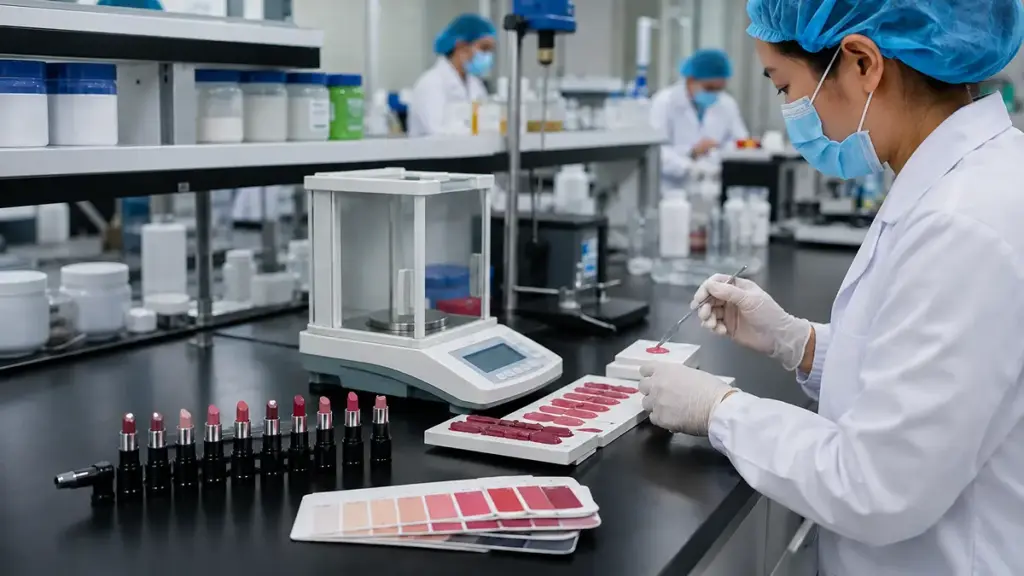
Getting cosmetic color right is tough. Raw materials are inconsistent, products change color as they dry, and different lighting completely alters how a shade looks.
Raw Material Variations
The ingredients themselves are a primary source of trouble. Pigments and fillers from suppliers can vary in shade, particle size, and opacity from one lot to another. This causes unpredictable shade drift between production runs, even when using the exact same formula. It’s a constant battle to keep colors consistent.
A color formula is not a standalone recipe; it lives within a base. If you change the base ingredients—like the oils, waxes, or film-formers—you alter how the pigments disperse and appear. You can’t just transfer a color formula from one lipstick base to another and expect the same result. The entire system has to be re-matched.
The manufacturing process introduces its own variables. How intensely pigments are ground or how long a batch is mixed can shift the final color. These issues become more pronounced during scale-up, when moving a perfectly matched 200g lab sample to a 100kg production batch.
Wet-to-Dry Color Changes
What you see in the bottle is not what you get on the skin. In liquid products such as foundation, color can change as volatile components evaporate and the formula dries down. The pigments may become more concentrated at the surface, so the final shade can appear different from the wet product. You have to formulate for the final, dried color, not the wet one.
Powders also shift based on their physical state. The color of a loose powder can look completely different once it’s compressed into a pan. The compression changes its density and how it reflects light, altering the perceived shade. You must match the color in its final, pressed form.
The application surface has a massive impact. A swatch on a plain white card can be useful for basic comparison, but it does not fully replicate how the color will appear on skin or in the finished product. That same swatch on skin, with its own undertones and translucency, will look entirely different. The color has to be evaluated on a surface that mimics its end-use environment.
Different Lighting Conditions
Two shades that are a perfect match under daylight can look noticeably different under the fluorescent lights of a retail store. This problem is called metamerism, and it’s a major challenge for any color-critical product. A foundation that matches by a window can look wrong in an office.
Because of this, color must be evaluated in controlled light booths that simulate multiple environments. A robust color-control program may evaluate samples under multiple standardized light sources, depending on the product and customer requirements.
Even the store shelf itself can be a problem. Strong shelf lighting can alter a product’s appearance, and the final packaging—whether it’s clear, frosted, or opaque—also plays a role. The color needs to be checked in its final, market-ready state to catch any last-minute shifts.
How Manufacturers Maintain Color Consistency in Mass Production
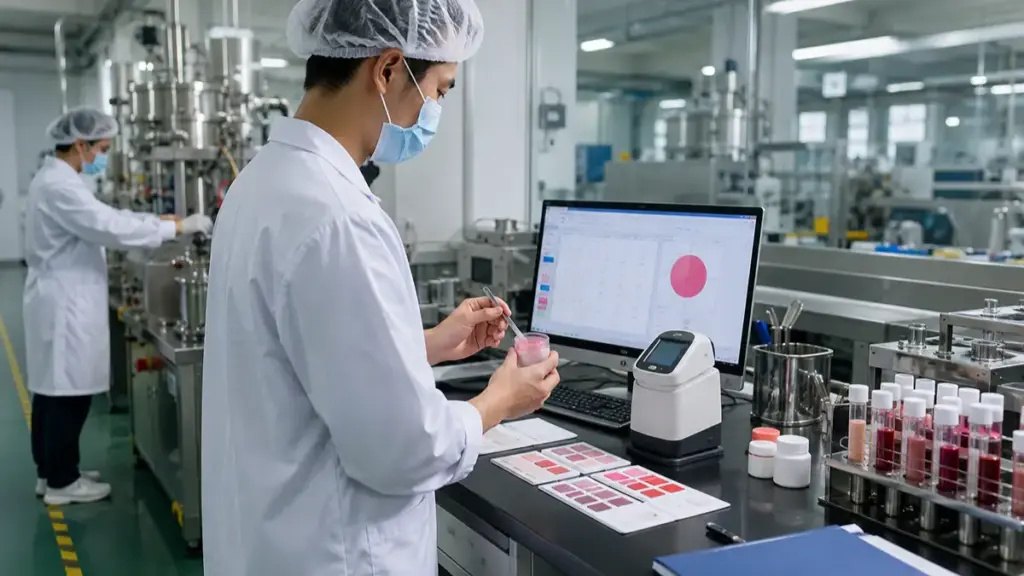
Maintaining color consistency in mass production requires coordinated controls over raw materials, formulation, processing, and color measurement.
Matching a shade at laboratory scale is only the first step. The bigger challenge is reproducing that result consistently during large-scale production. It relies on a two-part system: locking down the foundational elements before production starts, and then executing with rigid process controls during the run.
Foundational Controls: Standards, Materials, and Formulation
Before production begins, the color standard, raw material specifications, and acceptance criteria should be clearly defined. These controls give the production team a consistent reference for evaluating both materials and finished batches.
- Master Shade Standards: Each approved shade should have a controlled master standard, supported by a physical reference and recorded color data such as CIE Lumb* values. This master is the single source of truth that every batch is measured against.
- Numeric Tolerances (ΔE): Visual checks are subjective. Factories use a numeric tolerance called Delta E (ΔE) to define the acceptable difference between a production batch and the master standard. For some color-critical products, a manufacturer may set a tight internal tolerance, such as ΔE ≤ 1.0, depending on the product, measurement method, and customer requirements.
- Raw Material Control: Color consistency is extremely sensitive to raw material variations. Manufacturers may qualify suppliers and define specifications for pigment properties such as color strength and particle characteristics. Depending on the quality-control plan, incoming pigment lots may be checked against a reference before release. If a lot falls outside specification, the manufacturer can investigate whether the material should be accepted, adjusted for in formulation, or rejected.
The formula itself is engineered to be robust. Chemists select pigment blends and base ingredients (oils, waxes, fillers) that are less sensitive to small process fluctuations. They also manage for metamerism—the phenomenon where a color matches under store lights but fails in daylight—by testing formulas under multiple light sources during development.
Execution Controls: Process Management and Color Measurement
Once these specifications are established, production teams need to control process variables that can affect the final shade. It’s about making the process repeatable and using data to verify the outcome at every critical step.
First, every step is documented in Standard Operating Procedures (SOPs). This includes ingredient addition order, mixing speeds, heating and cooling temperatures, and milling times. In cosmetics, the quality of pigment dispersion is critical. epending on the product type, manufacturers may use milling, dispersing, or homogenizing equipment to improve pigment distribution and achieve more consistent color payoff. Poor dispersion leads to streaks and shade variation.
Throughout the process, color is measured with instruments. Depending on the quality-control plan, manufacturers may use spectrophotometers at selected checkpoints, such as pigment dispersions, bulk product, and finished goods. If a measurement shows the color drifting outside the ΔE tolerance, the batch is flagged. Technicians can then make tiny, calculated adjustments—like adding a minuscule amount of a corrective tint—to bring it back into specification before it’s filled.
In a more robust cosmetics quality-control program, instrumental measurements are complemented by visual checks under standardized lighting. In a robust color-control program, instrumental measurements can be complemented by trained visual evaluation under standardized lighting before final release. This ensures that what is numerically “correct” also looks right to the end consumer.
An OEM Partner Built for Scalable Makeup Production
Siloran supports makeup brands with an integrated R&D and manufacturing setup designed for customized cosmetic production. The company operates a 40,000-square-meter facility with dedicated workshops for lip makeup, powder products, daily chemical products, spraying, and batching. Its R&D team works alongside production teams throughout product development, while the manufacturing process can move from formulation design and sample testing to customer approval and mass production within one coordinated workflow. Siloran also operates GMP-compliant clean production areas and holds GMPC and ISO22716 certifications. Automated filling, capping, cooling, packaging, and other production equipment support repeatable manufacturing across different makeup formats. Raw material selection is managed with supplier screening and compliance requirements, while product quality is supported by in-process controls and third-party testing through organizations such as SGS. This combination gives brands a practical foundation for developing customized makeup products and scaling approved formulations into commercial production.
Frequently Asked questions
How do makeup OEM factories handle color matching?
Makeup OEM factories use a precise, multi-step process. It begins with a brand’s brief, including a physical color standard and performance goals like a matte finish. The factory’s lab develops the product formula and adjusts an appropriate combination of colorants or pigments to build the target shade. They use scientific instruments called spectrophotometers to measure the color numerically (as L*a*b* values) and ensure the match is within a tight tolerance (ΔE). This data is combined with visual assessments under various lighting conditions to confirm the shade appears correct. After the required stability and product evaluations are completed, the approved formula can be scaled for production, with quality controls in place to maintain batch-to-batch consistency.
Why does my foundation shade look different in sunlight versus store lights?
This happens because different light sources interact with your skin and the foundation’s pigments in unique ways, a phenomenon called metamerism. Different light sources can change how a foundation shade appears because the product and skin reflect light differently under different illumination. A shade that looks close under one light source may show a noticeable mismatch under another. The foundation’s base formula and post-application changes, such as drying, can also affect how the shade looks on skin. In some formulations, oxidation may contribute as well.
Considerações finais
Relying on visual checks alone can make color decisions inconsistent. A stronger quality-control system combines instrumental color measurement, defined ΔE tolerances, and trained visual evaluation under controlled lighting. Your signature shade is a core asset; its consistency is non-negotiable.
Don’t guess on quality—verify it. Submit your color standard for a lab-matched sample to evaluate our process firsthand. Entre em contato com nossa equipe to discuss your product specifications and lock in your color standards.