

This guide breaks down the essential cosmetics manufacturing process to ensure batch consistency and regulatory compliance in high-volume production. We evaluate every critical stage against strict GMPC benchmarks—from raw material verification and 3500 RPM high-shear vacuum emulsification to automated filling line setups and ISO 8 cleanroom filtration standards. Whether you are scaling a beauty brand or evaluating contract manufacturers, this technical analysis provides the exact quality control protocols and digital traceability metrics needed to eliminate contamination risks, minimize defect liabilities, and secure a scalable, market-ready output.
Raw Material Preparation
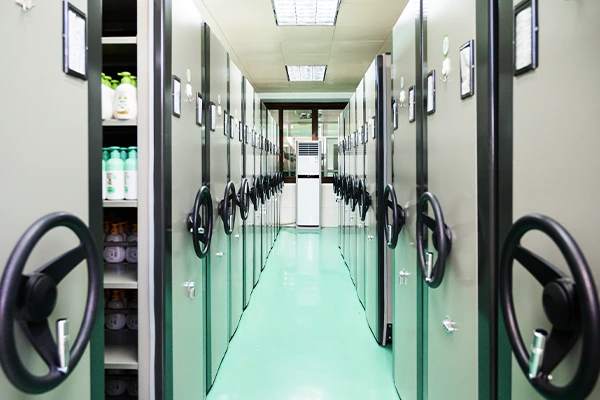
Effective raw material preparation builds the foundation of a sterile cosmetics manufacturing process. To prevent downstream contamination and batch variance, facilities must implement rigorous verification protocols before ingredients enter the active production line.
- BOM & Regulatory Alignment: Sourcing teams lock down the Bill of Materials (BOM) to verify exact chemical compositions and purity levels against strict GMPC and FDA standards.
- Inbound Technical Inspections: Quality assurance teams run immediate physical and chemical testing on arriving raw lots, evaluating stability, active ingredient strength, and microbial baselines.
- Automated, Sterile Inflows: Verified ingredients transfer through closed, GMP-compliant automated feeding systems. This mechanical intervention eliminates manual handling, securing a continuous, contaminant-free material inflow for subsequent mixing phases.
Mixing and Emulsification
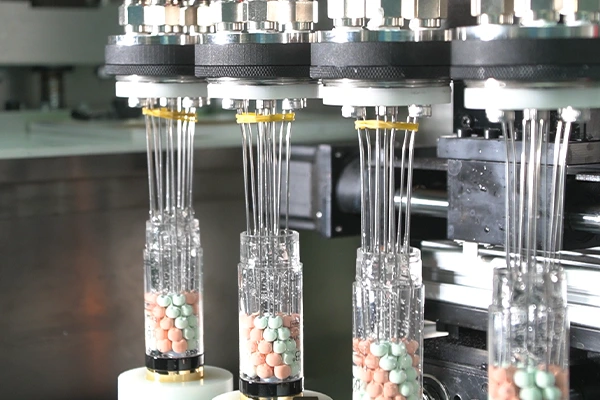
The mixing and emulsification phase dictates the stability, pigmentation, and clumping resistance of the final mascara. GMPC facilities utilize a precise, three-stage thermal and mechanical sequence to transform raw ingredients into a high-performance cosmetic paste.
Phase Preparation and Wax Melting
Operators separate the formulation into independent oil-soluble and water-soluble phases.
- Thermal Control: Special melting tanks heat the oil phase (typically comprising carnauba wax, beeswax, and stearic acid) up to 85°C to achieve a completely uniform, liquid state.
- Pigment Dispersion: Iron oxide pigments are pre-dispersed within the liquid phase under high agitation to ensure intense, streak-free color development.
High-Shear Vacuum Emulsification
Once both phases reach identical target temperatures, they transfer into the main vacuum emulsification mixer.
- Vacuum Transfer (-0.09 MPa): Atmospheric pressure drops to -0.09 MPa to draw the phases into the sealed main tank, preventing any air entrapment or oxidation.
- 3500 RPM Homogenization: A precision rotor-stator homogenizer runs at speeds up to 3500 RPM. This intense centrifugal shear breaks the formulation down into uniform micro-droplets (200 nm to 2 μm), preventing particle coalescence.
Viscosity Locking and Deaeration
The paste must undergo structured cooling to stabilize its unique gel matrix.
- Active Scraper Recirculation: Low-speed wall scrapers run at 0 to 60 RPM, continuously driving the hot formulation from the vessel walls back into the active cooling zone to prevent localized over-cooling.
- Vacuum Deaeration: The continuous vacuum environment strips out micro-bubbles, ensuring a smooth, high-density paste ready for bubble-free discharge.
Premium Private Label Eye Makeup Solutions

Filling and Embalagem
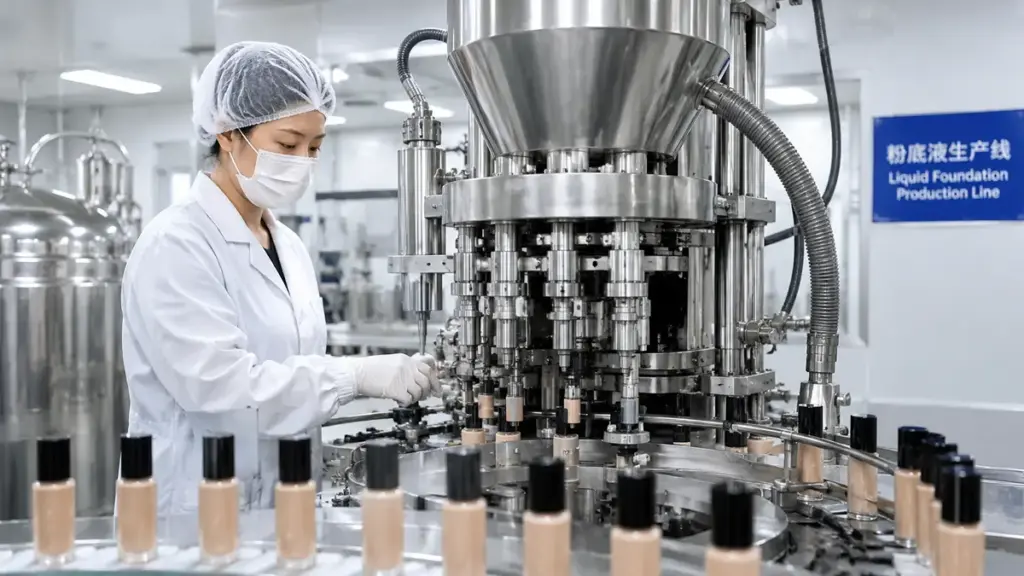
High-volume mascara production requires smart automation. Because mascara paste is thick and sticky, manual filling leads to mess and errors. Automated lines solve this by keeping production clean and fast.
- Precision Servo Filling: The line uses double-servo-driven piston fillers to pump the formula into tubes. The filling nozzles are heated. This keeps the thick paste flowing smoothly and stops clogs or messy spills.
- Automatic Assembly: Machines take over the tricky parts. They automatically press the plastic wipers into the tubes, then feed, place, and screw on the caps tightly. No human hands touch the product here, keeping it completely sterile.
- Sensors & Labeling: Before packing, optical sensors check every single tube to make sure the caps are sealed correctly. Finally, high-speed automated machines apply the labels perfectly straight.
By cutting out manual labor, this automated setup keeps your production costs low, prevents contamination, and ensures every single tube in your bulk order looks exactly the same.
Batch Coding and Traceability
Batch coding is not just a regulatory requirement; it is your brand’s insurance policy. A digital traceability system links your raw ingredients directly to the finished mascara tubes, making quality control simple and transparent.
- Smart Alphanumeric Coding: High-speed inkjet or laser printers apply a unique batch code to every tube. This code acts as a digital fingerprint, recording production dates, exact formula lots, and chemical processing temperatures.
- ERP System Integration: Factory scanners upload these codes directly into an Enterprise Resource Planning (ERP) platform. If a component or ingredient has an issue, software maps the problem instantly without manual paperwork.
- Targeted Risk Management: If a quality issue ever surfaces, you do not need to recall an entire shipment. Managers use the batch code to isolate the exact affected run, saving thousands of dollars in good inventory.
Cleanroom Environment (100,000 Grade GMP)
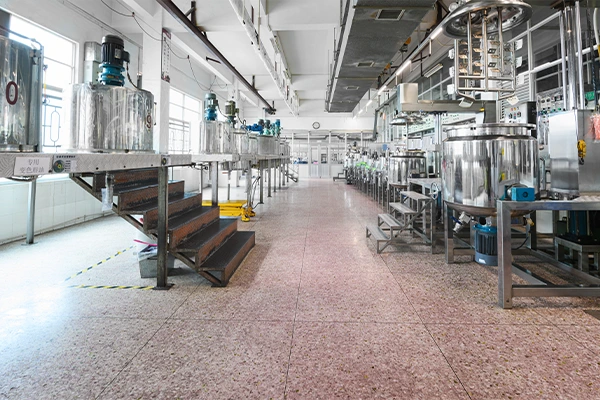
Class 100,000 cleanrooms provide a baseline controlled environment (ISO 8 / GMP Grade D) for non-critical manufacturing stages like solution preparation and terminal sterilization support.
Classification Standards and Particle Limits
The legacy FS209E standard originally defined Class 100,000 based on cubic feet, but modern manufacturing relies on ISO and GMP metrics. Today, this classification establishes the baseline hygiene level for high-containment factory operations.
- FS209E Standard: Limits airborne particles to ≤100,000 per cubic foot for sizes ≥0.5 μm.
- ISO 14644-1 Equivalence: Aligns with ISO 8 at rest, permitting up to 3,520,000 particles per cubic meter.
- EU Annex 1 GMP: Matches this limit to Grade D, functioning as the primary background zone for higher-grade areas.
| Standard / Framework | Particle Limit (≥0.5 μm) | ISO Equivalent | GMP Grade |
|---|---|---|---|
| FS209E (Legacy) | ≤100,000 / ft³ | ISO 8 | Grade D |
| ISO 14644-1 (At Rest) | ≤3,520,000 / m³ | ISO 8 | Grade D |
Design Specifications and Operational Applications
Managing a Class 100,000 cleanroom requires specific airflow physics to dilute airborne contaminants continuously. Facility engineers balance air exchange rates with precise filtration coverage to maintain constant compliance.
- Airflow Dynamics: Maintain a minimum of 20 air changes per hour (ACH) to dilute particles in high-containment areas.
- Filtration Setup: Install HEPA filters covering 4% to 5% of the ceiling to achieve an airflow of 4 to 8 CFM/ft².
- Approved Operations: Utilize the space for less critical operations like solution preparation, weighing non-sterile materials, and supporting Grade C filling zones.
- Environmental Monitoring: Implement continuous particle monitoring and microbial viability testing to keep counts below 200 CFU/m³ at rest.
Final Inspection and Quality Control
Final quality control is your last line of defense. Catching a defect before shipment protects your brand reputation and eliminates the massive costs of product recalls.
- Finished Paste & Application Testing: Lab technicians evaluate the final batch for exact color matching, pH balance, and proper viscosity. They perform actual brush-out tests to guarantee the mascara goes on smoothly without clumping or smudging.
- Tube & Functionality Checks: Inspectors verify the physical tubes. They test the torque of the caps, ensure the inner wipers strip excess paste perfectly, and run vacuum leak tests to prevent any oozing during transit.
- Transit & Label Validation: Workers check the final shipping cartons for proper shock absorption to withstand global freight. They also cross-check that all batch codes and ingredient labels are visible and legally compliant.
Considerações finais
Partnering with an unverified factory to cut upfront costs often leads to contaminated batches and catastrophic product recalls. Operating under strict GMPC standards with ISO 8 cleanrooms is the only reliable way to safeguard your cosmetic brand’s reputation. Controlling the environment from raw materials to automated filling ensures scalable, defect-free production.
Stop guessing on your supply chain. Partner with Siloran to align your custom eye makeup formulations with our high-volume OEM/ODM capabilities. We recommend starting with a factory audit or requesting a custom sample run to experience our emulsion stability firsthand. Contact our production team today to secure your manufacturing capacity.
Frequently Asked Questions
Where is mascara manufactured?
China dominates global mascara production. Manufacturing hubs like Qingdao, Pingdu, Jinhua, and Guangzhou handle over 80% of eyelash and mascara exports. Major cosmetics brands like L’Oréal and Estée Lauder maintain distributed global facilities to guarantee high-volume output and localized compliance. Manufacturers also operate private-label facilities across the United States and Europe to support custom formulations and rapid regional supply.
How do factories make mascara?
Factories blend core ingredients like waxes, pigments, oils, and binders using either anhydrous or emulsion methods. During the emulsion process, equipment heats and blends an oil-soluble phase and a water-soluble phase separately. A homogenizer then combines them to form a dark paste. Facilities continuously heat the mixture during blending to prevent the wax from solidifying. Technicians test the batch for proper pH and viscosity before pumping the formula into consumer tubes.
What is a GMPC certified factory?
A GMPC (Good Manufacturing Practice for Cosmetics) certified factory operates under strict guidelines tailored specifically to cosmetics production. This certification verifies that the facility maintains systematic controls over hygiene, equipment cleanliness, raw material procurement, and personnel training. By implementing these protocols, factories minimize contamination risks and ensure safe, consistent product output across high-volume manufacturing lines.
How do automated lines fill mascara tubes?
Manufacturing lines utilize precision machinery to pump heated liquid mascara directly into upright tubes. The equipment continuously mixes and heats the formula during this stage to prevent the gel from cooling and clogging the dispensing nozzles. After filling the tubes, machines insert clear plastic wiper plugs to strip excess product from the brush, then press in a stopper to seal the unit tightly against leaks.
What role does cosmetic batch coding play in production?
A batch code acts as a unique alphanumeric identifier assigned to a specific production run. Manufacturers use these codes to track production dates, formulas, and raw material sources within their management systems. Factory operators print these codes directly onto packaging using inkjet or laser technology. This system enables rapid product recalls, anti-counterfeit verification, and strict compliance with global safety regulations.
How do buyers verify a factory’s production capacity?
Buyers verify capacity by analyzing operational factory data, including available machine hours, workforce deployment, daily output rates, and equipment downtime. Evaluators conduct pre-production, active-production, and end-of-production inspections to compare the factory’s theoretical maximum output against realistic performance. Facility audits also confirm the plant maintains well-organized, mature processes capable of handling large volumes without compromising product quality.



 Portuguese
  English
  Arabic
  Dutch
Dutch  French
  Russian
  Spanish