

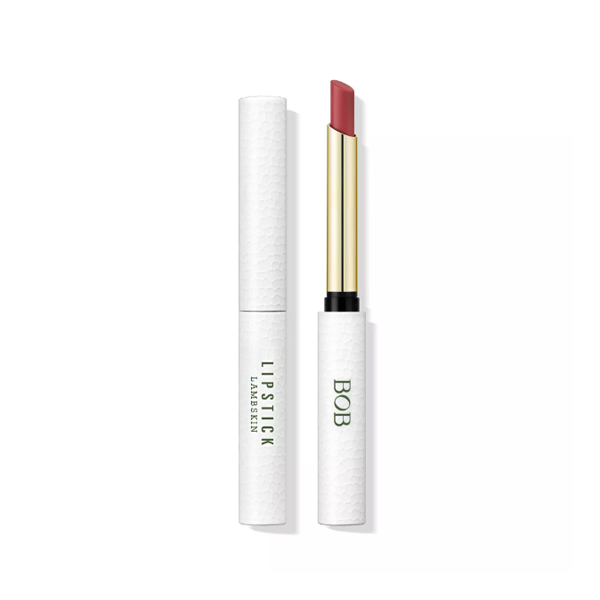
Understanding the lipstick filling process helps brands and product developers evaluate how manufacturing decisions influence product consistency, production efficiency, and overall quality. Factors such as temperature control, filling accuracy, and cycle management all play important roles in large-scale lipstick production.
This guide compares manual and automated lipstick filling methods while explaining key production factors, including mold selection, filling temperatures, and flame finishing. These factors help manufacturers maintain consistent quality and improve production efficiency at different scales.
How Lipstick Is Manufactured
Lipstick manufacturing is a controlled process of melting ingredients, molding the hot liquid into a bullet shape, cooling it solid, and assembling it into a consumer-ready case. Learn more about our solid lipstick manufacturing solutions.
| Step | Key Actions |
|---|---|
| Step 1: Formula Preparation | Melting waxes and oils, dispersing pigments using high-shear mills, and mixing everything into a uniform liquid base. |
| Step 2: Lipstick Filling | Dosing the hot liquid mass into molds that define the bullet’s final shape. Molds are typically silicone or metal. |
| Step 3: Cooling & Solidification | Passing filled molds through controlled cooling tunnels or refrigeration units to harden the liquid into a solid stick. |
| Step 4: Demolding & Case Assembly | Mechanically ejecting the solid bullet from the mold and inserting it securely into its final twist-up case mechanism. |
| Step 5: Flame Finishing & QC | Passing the bullet through a brief flame for a glossy finish, followed by visual and mechanical quality inspections. |
Step 1: Formula Preparation
The process starts by creating the lipstick base.Waxes and oils are heated in controlled mixing vessels, with processing temperatures adjusted according to the formula and ingredient characteristics.
Once both phases are fully melted, they are combined and mixed. The most critical part is pigment dispersion. Pigments are ground into a portion of the oil using high-shear equipment like a triple-roll mill to break down clumps and ensure a smooth, non-gritty color. This pigment grind is then mixed into the main wax and oil base.
After the color is uniform, the batch is cooled slightly to add heat-sensitive ingredients like fragrances or certain additives. The final mass is often filtered and de-aerated under vacuum to remove any bubbles before it moves to the filling line.
Step 2: Lipstick Filling
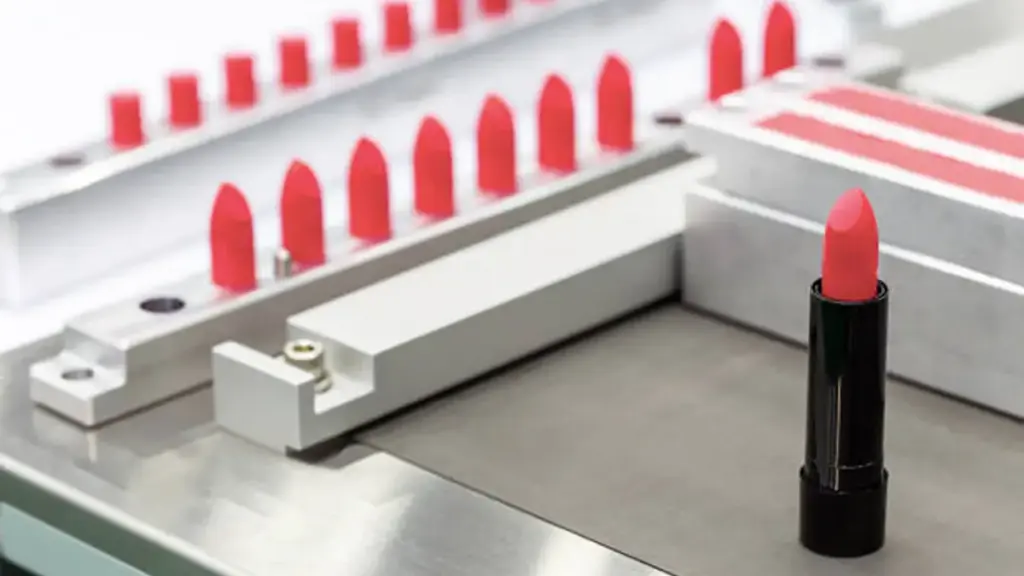
The hot, liquid lipstick mass is transferred to a holding tank on the filling line, where it’s kept at a precise temperature to maintain a pourable viscosity. From there, automated nozzles dose a specific volume of the liquid into molds. The choice of mold material depends on the production scale and desired finish.
- Silicone Molds: These flexible molds are commonly used for smaller batches, custom designs, or products requiring easier demolding. Their elasticity allows lipstick bullets to be released with minimal force, although they are generally less suitable for high-speed automated production due to lower rigidity and durability compared with metal molds.
- Metal Molds: Typically made of aluminum, these are the standard for large-scale production. They offer high dimensional accuracy and excellent heat transfer, which allows for faster cooling and shorter cycle times. On automated lines, the lipstick is filled upside down, with the bullet tip forming at the bottom of the mold.
Step 3: Cooling and Solidification
Once the molds are filled, they must be cooled in a controlled environment to solidify the lipstick correctly. In high-volume facilities, molds travel through automated cooling tunnels with regulated air temperature and flow.
For smaller-scale operations using silicone molds, trays are often placed in refrigerators or freezers.The goal is to achieve a controlled cooling rate that allows the lipstick to maintain its shape while reducing the risk of surface defects, cracking, or internal stress. As the lipstick cools, it contracts slightly, which helps it pull away from the mold walls for an easier release.
Step 4: Demolding and Case Assembly
After the bullets are fully solid, they are removed from the molds. With silicone molds, operators can simply flex the material to pop the bullets out. For metal molds in automated lines, mechanical systems take over. This often involves a quick blast of air or mechanical pushers that eject the bullets directly from the mold cavity into the empty lipstick case mechanism waiting below.
The bullet is inserted into the inner cup of the case, and some lines gently heat the base to ensure it adheres securely. The mechanism is then tested to make sure the bullet twists up and down smoothly without scraping the case walls.
Step 5: Flame Finishing and Quality Inspection
The final step ensures a perfect cosmetic appearance and functional quality. Flame finishing is a common technique where the extended lipstick bullet passes quickly through a controlled flame. This melts the very thin outer layer, which immediately re-solidifies into a smooth, glossy finish, removing any minor imperfections like tiny pores or scratches from the molding process.
After flaming, the lipsticks undergo rigorous quality inspection. Testers check for visual defects, color uniformity, and mechanical performance like break strength and proper mechanism function. Lipsticks that meet the required quality standards move on to final capping, labeling, and packaging.
Launch Your Custom Lipstick Line, Faster
How Manufacturers Improve Production Efficiency
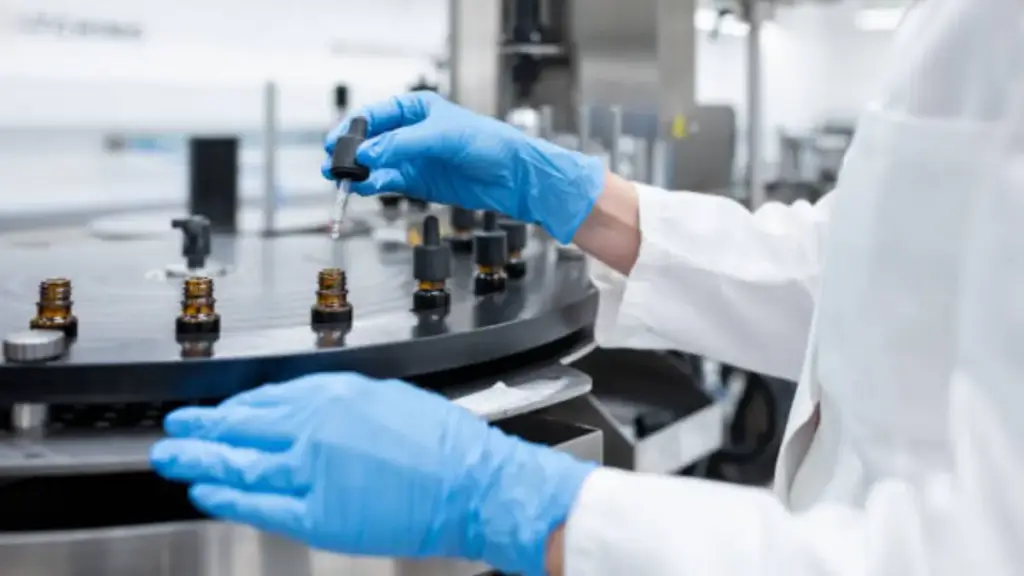
Efficiency in lipstick production is achieved through the combination of suitable automation, optimized formulations, and effective process control. These factors can help manufacturers improve production consistency and manage resources more efficiently.
Automating and Integrating the Production Line
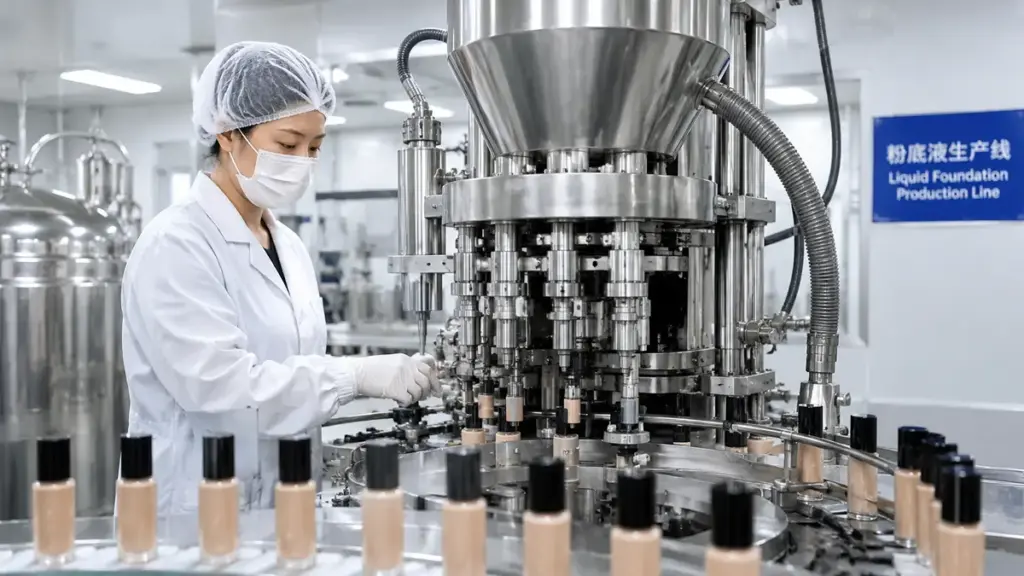
The biggest leap in efficiency comes from replacing manual or older methods with automated filling machines. These systems use precise volumetric piston fillers to dose the lipstick mass into molds. This shift can improve filling consistency and production efficiency by reducing manual variation and allowing more precise control over filling volumes.
Larger-scale cosmeticafabrikanten often integrate multiple production stages into a connected workflow rather than automating filling alone. A modern line connects filling, cooling, demolding, case assembly, and packaging into a single, continuous flow.
Instead of moving batches of products between stations, the line moves individual units seamlessly. This setup minimizes manual handling, which is slow and risks damaging the product. Molds travel through automated cooling tunnels, and robotic systems transfer the solidified bullets directly into their cases, often followed by automatic capping and visual inspection.
- Integrated Machinery: Many machines combine melting, dosing into molds, and cooling in one system. This reduces the physical footprint and shortens the time between steps.
- Streamlined Workflow: Automating the chain from filling to demolding and assembly reduces cycle time. Some integrated production lines can significantly shorten the time from filling to finished product preparation, depending on the production setup and quality requirements.
- Automated QC: Vision systems can inspect for fill level, surface quality, and correct labeling without slowing down the line, catching defects early.
Optimizing Formulation and Minimizing Waste
Efficiency starts before the filling machine is even turned on. Formulators adjust the wax-oil-pigment system to shorten processing time. Using wax blends with lower or narrower melting ranges cuts down the heating phase. Employing pre-milled pigments reduces the time needed for high-shear dispersion, a notoriously slow step. Some manufacturers create a standardized base mass that can be quickly tinted, avoiding the need to run a full melt-and-mix cycle for every single shade.
Upgrading the mixing equipment also pays off. Compared with basic mixing methods, steam-jacketed kettles and high-shear mixers can provide more controlled heating and pigment dispersion for consistent lipstick batches. This shortens the time it takes to get a homogeneous, pourable mass ready for the filling line.
Reducing physical waste is another key area. Precision fillers with anti-drip valves and suck-back functions prevent spillage and messy container rims, which means less product loss and less downtime for cleaning. Fast changeovers between different shades are also critical. Machines designed for tool-less changes and a smart production schedule—running shades from light to dark—minimize the time and materials needed for cleaning between batches.
Frequently Asked Questions
How is lipstick filled into tubes during mass manufacturing?
Manufacturers typically do not fill molten lipstick directly into the final tube. Instead, a molten lipstick mass is dosed into metal molds that are integrated with the lipstick’s twist-up base. The lipstick solidifies ‘upside-down,’ already attached to its mechanism. After filling, the molds pass through cooling tunnels. Once solid, the finished lipstick bullet is released from the mold, often flame-finished for gloss, retracted into its case, capped, and packaged.
What is the difference between silicone and aluminum lipstick molds?
Aluminum and silicone molds serve different production requirements. Aluminum molds are widely used for large-scale manufacturing because they offer good durability, dimensional accuracy, and efficient heat transfer. However, they may leave a visible parting line depending on the mold design and process conditions. Silicone molds are a premium option for luxury products. They create a completely seamless bullet and are excellent for embedding complex patterns or logos, but they are more expensive and have a shorter operational life.
Why do some lipsticks have lines or seams on the side?
A line or seam on the side of a lipstick is a normal result of the molding process, not a defect. It’s most often a ‘parting line’ created where the two halves of the metal mold meet. When the molten lipstick cools and hardens, it takes on a faint impression of this seam. Other minor lines can also come from the flow of the liquid lipstick or from the cooling and handling stages.
What is flame finishing in lipstick manufacturing?
Flame finishing is a cosmetic step where a newly molded lipstick bullet is passed very briefly through a controlled flame. This action melts the thinnest outer layer of the lipstick, which immediately re-solidifies into a smooth, glossy surface. The process removes minor imperfections like pinholes or mold marks, giving the lipstick a flawless, professional look.
At what temperature is lipstick melted and poured into molds?
Lipstick is commonly melted and processed at around 75–85 °C, depending on the formula and ingredient characteristics. Before filling, the molten lipstick mass is usually adjusted to a suitable pouring temperature to maintain smooth flow and ensure consistent molding results.
How do cosmetics factories ensure automated lipstick bullets don’t break?
Preventing breakage involves a combination of formulation, engineering, and process control. The formula itself is balanced with waxes and oils for both strength and flexibility. During manufacturing, cooling rates are carefully managed to prevent internal stress and cracks. The bullet’s shape and the tube’s internal support mechanism are also designed to minimize stress. Automated systems use gentle, precise motions for handling, and finished lipsticks undergo mechanical tests to confirm they can withstand shipping and daily use.
Laatste gedachten
Understanding the lipstick manufacturing process is only the first step. Consistent product quality depends on precise formulation, controlled production conditions, and effective quality management throughout the manufacturing process.
For brands developing new lipstick products, choosing an experienced OEM lipstick manufacturer can help ensure reliable production, flexible customization, and consistent results at different production scales. Contact our team to discuss your lipstick formula, packaging requirements, and OEM production needs.

 Dutch
Dutch  English
  Arabic
  French
  Portuguese
  Russian
  Spanish